
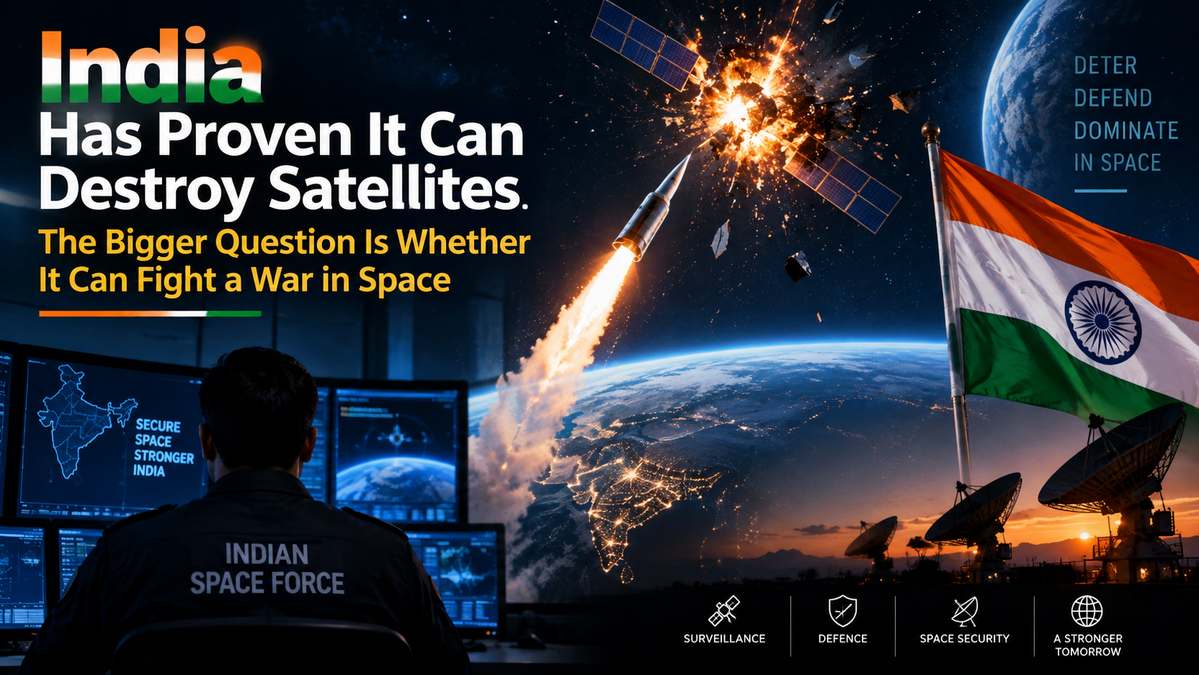
The idea of war in space once sounded like science fiction. That is changing quickly.
The United States has now publicly acknowledged that it has deployed what it describes as “on-orbit space control weapons,” although Washington has not revealed exactly what those systems are capable of doing. The disclosure has brought a long-running debate into sharper focus: if a major conflict extends into space, how prepared are countries to protect their satellites and disrupt an opponent’s space infrastructure?
For India, the answer is more complicated than simply pointing to its successful anti-satellite test in 2019.
India has already demonstrated that it can destroy a satellite from the ground. But modern space warfare involves much more than firing an interceptor at a target. It can involve surveillance, communications, navigation, electronic interference, cyber operations, satellite manoeuvring, rapid replacement of damaged spacecraft and the ability to continue military operations even when parts of a satellite network are under attack.
That distinction could become increasingly important as the US, China and Russia expand their counter-space capabilities.
Mission Shakti Put India on the ASAT Map
India’s biggest public demonstration of an anti-satellite capability came on March 27, 2019, during Mission Shakti.
The Defence Research and Development Organisation used a modified ballistic-missile defence interceptor to target Microsat-R, an Indian satellite in low Earth orbit. The interceptor destroyed the satellite through a direct collision, a technique known as a kinetic “hit-to-kill” attack.
The successful test made India the fourth country, after the United States, Russia and China, to publicly demonstrate a direct-ascent anti-satellite capability.
It was an important technological demonstration. It showed that India could detect and track an object in orbit and guide an interceptor toward it with enough precision to achieve a high-speed collision.
But there is an important difference between demonstrating a capability once and building a complete military space-warfare architecture.
That is where the bigger question begins.
Destroying One Satellite Is Not the Same as Fighting a Space War
Imagine an army proving that it can destroy one enemy tank. That would demonstrate an important weapon capability, but it would not necessarily prove that the army could sustain a long conventional war.
Space warfare presents a similar problem.
An ASAT missile is only one tool. A country also needs reliable systems to identify potential threats, continuously monitor objects in orbit, protect its own spacecraft and maintain communications with forces on Earth.
Modern militaries depend heavily on satellites for communications, navigation, intelligence, surveillance and targeting. The United States, China and India all operate satellite systems that contribute to national security and military operations.
So the real contest may not begin with satellites exploding in the sky.
It could begin with a satellite losing its communication link, navigation signals becoming unreliable or an operator suddenly discovering that an unfamiliar spacecraft has moved unusually close.
Space Warfare Does Not Always Mean Explosions
One of the biggest misconceptions about space warfare is that every attack would involve a missile destroying a satellite.
That is only one possibility.
Electronic warfare could be used to interfere with communications. Cyber operations could target ground infrastructure controlling satellites. A spacecraft capable of manoeuvring close to another satellite could potentially interfere with or inspect it.
China’s Shijian-21 mission demonstrated why manoeuvrable spacecraft are attracting attention. In 2022, the satellite was reported to have interacted with a defunct satellite and changed its orbit, demonstrating a capability that has both civilian and potential military implications.
This means future space conflicts could resemble a complicated chess match rather than a simple missile exchange.
The first move might not even be visible from Earth.
China and the US Are Building Broader Space Capabilities
China has developed a significant military-space architecture and treats space as an important component of future military operations. The US Space Force has publicly described Chinese and Russian counter-space developments as a growing strategic challenge.
The United States, meanwhile, has created a dedicated Space Force and has now acknowledged the existence of weapons deployed in orbit. The exact nature and capabilities of those weapons remain undisclosed, making it difficult to draw a precise comparison with India’s publicly known systems.
This is an important point.
It would be misleading to compare India’s 2019 ASAT demonstration directly with an unspecified US orbital weapons capability and conclude that one country is simply “ahead” because it possesses a particular weapon.
Space power is a much larger equation.
Where Does India Stand?
India is not starting from zero.
Following Mission Shakti, India strengthened the institutional side of its military-space efforts. The Defence Space Agency was established to coordinate space-related military activities, while efforts such as Project NETRA have focused on space situational awareness — essentially, knowing what is moving around India’s satellites and identifying potential threats.
India has also conducted dedicated military exercises involving space-related scenarios. Its military space architecture includes communications, reconnaissance, navigation and other satellite capabilities.
Recent reporting also points to India’s plans to expand its space-based surveillance infrastructure substantially.
These developments matter because a country cannot protect satellites it cannot adequately monitor.
The Satellite Network May Matter More Than the Missile
For India, perhaps the more important question is not whether another ASAT missile can be produced.
It is whether India’s military can continue operating if an adversary attacks several satellites simultaneously.
That requires redundancy.
If one communications satellite is disrupted, another system should be able to take over. If navigation services are degraded, alternative methods should exist. If a surveillance satellite becomes unavailable, another sensor should ideally fill part of the gap.
This is similar to having multiple roads connecting the same cities. Destroying one road causes disruption, but it does not stop the entire transportation system if alternative routes are available.
The same principle applies in space.
A resilient satellite network can be more valuable during a conflict than a single spectacular weapon.
India’s Biggest Challenge May Be Space Resilience
India’s publicly demonstrated ASAT capability answers one question: Can India physically intercept and destroy a satellite in low Earth orbit?
Mission Shakti showed that it can.
But several other questions remain less visible from publicly available information.
Can India rapidly detect a hostile spacecraft approaching one of its satellites? Can it protect its communications links from interference? Can it maintain military operations if navigation or surveillance satellites are degraded? Can it quickly replace damaged or disabled spacecraft? And can its armed forces coordinate space-based information during a prolonged conflict?
These are much harder questions.
Public information does not establish that India currently possesses an orbital offensive weapons arsenal comparable to what the United States has now acknowledged, nor does it demonstrate that India has replicated the full breadth of China’s military-space capabilities.
The Debris Problem Makes Space Warfare Different
There is another reason countries cannot treat ASAT weapons like ordinary missiles.
Destroying a satellite can create thousands of pieces of debris travelling at extremely high speeds. Those fragments can threaten other spacecraft, including satellites belonging to the country that launched the attack.
This creates a dangerous paradox: a successful attack could damage the wider space environment on which everyone depends.
India’s 2019 test was conducted at a relatively low altitude, and Indian officials said the choice was intended to reduce the long-term persistence of debris.
The problem, however, remains global. Once debris is created, it does not respect national borders.
The New Space Race Is About More Than Weapons
The latest developments suggest that the emerging competition in space is becoming broader.
The United States is openly discussing space-control capabilities. China continues to develop sophisticated counter-space systems. Russia also has a substantial history of anti-satellite and counter-space development. India, meanwhile, is building on the capability demonstrated by Mission Shakti while expanding its military-space infrastructure.
That means the next phase of the space race may not simply be about who can destroy the most satellites.
It could be about who can keep their own satellites functioning when someone is trying to disable them.
India Has the Weapon. The Bigger Test Is the System Around It
Mission Shakti gave India an important place in the small group of countries that have demonstrated a kinetic ASAT capability.
But a single successful interception is not the same thing as being prepared for a full-scale space conflict.
The next generation of military space capability will depend on surveillance, resilient satellite networks, secure communications, electronic warfare, cyber defence, rapid replacement and the ability to operate when space-based services are disrupted.
That changes the central question.
It is no longer simply “Can India shoot down a satellite?”
The more consequential question is: Can India continue to fight, communicate, navigate and gather intelligence if an adversary tries to turn space itself into a battlefield?
The answer will depend less on one missile than on the strength and resilience of the entire system surrounding India’s satellites.