
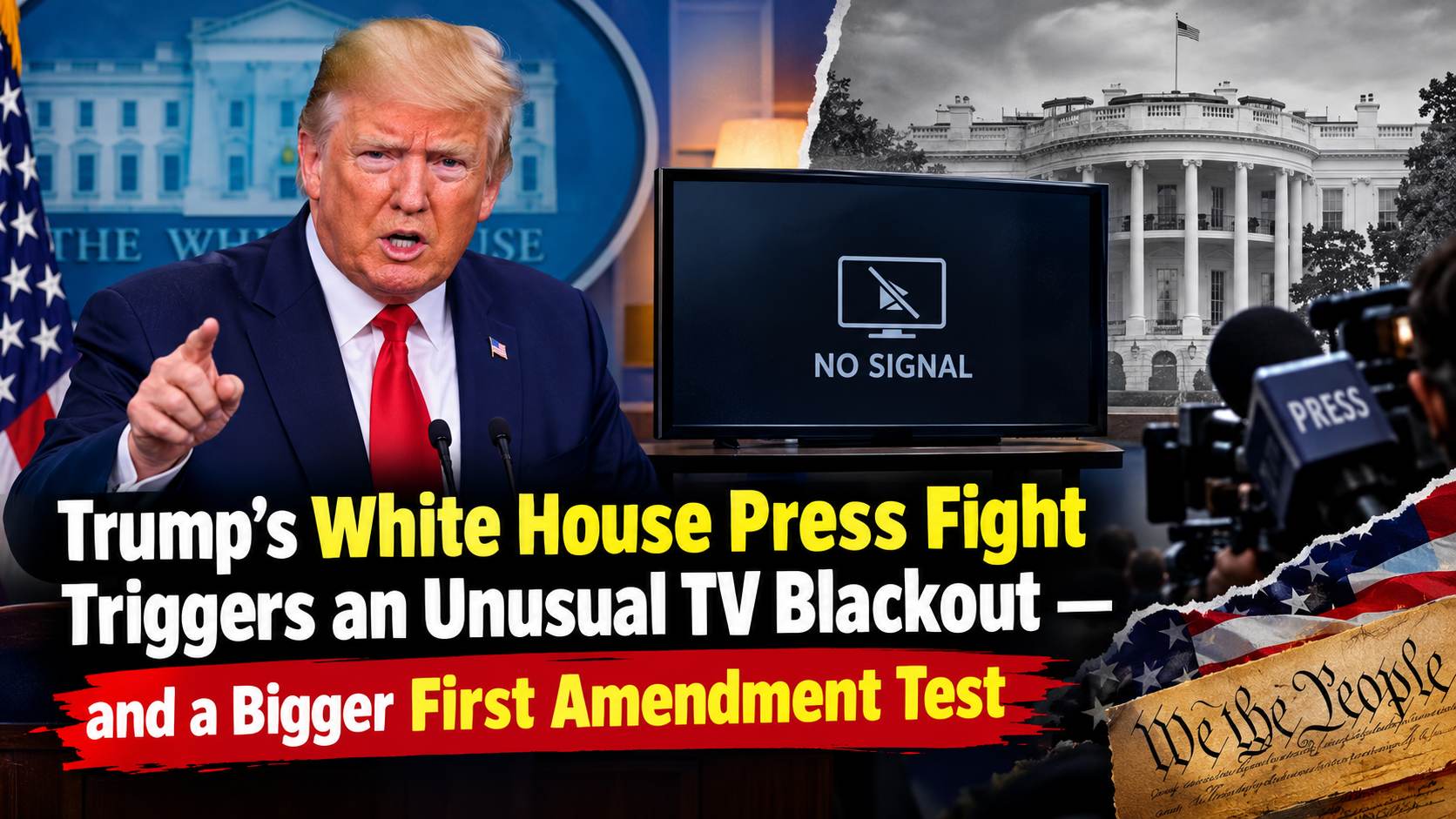
For a brief and unusual moment in September, Americans watching President Donald Trump’s White House events faced something rarely seen in modern U.S. political coverage: the cameras were not where they normally were.
The disruption began after the White House barred journalists from CNN, MS NOW and Politico from its grounds. The three organizations responded by filing a federal lawsuit, arguing that the administration had violated their First Amendment rights and improperly revoked their access.
But the dispute quickly grew beyond those three outlets.
CNN is one of five organizations that normally rotate responsibility for the White House television pool, alongside ABC, CBS, Fox News and NBC. When the administration prevented CNN from performing its assigned pool duties, the other networks suspended the shared coverage rather than allowing the White House to simply replace CNN.
That decision created an extraordinary information gap. For a system built around sharing presidential video with broadcasters across the country, removing one participant suddenly raised a much bigger question: Who gets to decide which journalists are allowed to cover the president?
A Media Dispute Turned Into a Coverage Problem
The White House said the banned outlets had engaged in what Trump described as false or unfavorable reporting. Trump argued that his administration was not attacking the free press but fighting what he called “fake news.” The administration also maintained that access to the White House is a privilege rather than an unconditional right.
The news organizations saw the situation differently.
CNN, MS NOW and Politico argued that the government should not be able to punish news organizations by removing access because officials dislike their reporting. Their lawsuit asked the court to intervene and restore their access.
The disagreement therefore moved beyond the familiar Trump-versus-media argument. It became a constitutional question about whether government officials can use physical access to the presidency as leverage over news organizations.
And that distinction matters.
The White House is not an ordinary workplace. Presidents routinely appear there to announce policies, respond to crises and meet foreign leaders. Reporters with access can ask questions directly and observe events that may not be fully captured by an official government video feed.
If access becomes dependent on whether coverage is favorable, the relationship between government and press changes fundamentally.
Why Fox News’ Decision Made the Blackout More Significant
Perhaps the most striking part of the episode was that the response was not limited to outlets traditionally seen as critical of Trump.
Fox News, ABC, CBS and NBC joined CNN in suspending the White House television pool after CNN was prevented from carrying out its scheduled duties. The networks said the public has a vital interest in receiving independent information about its government and that an administration should not restrict a news organization because it objects to its reporting.
That created an unusual show of solidarity across the American television news industry.
The significance was practical as well as symbolic. The television pool exists because it is inefficient—and sometimes impossible—for every network to send its own cameras everywhere the president goes.
Instead, the networks rotate responsibility and share the footage.
Think of it as a relay system. One organization carries the camera responsibility, then passes the material to everyone else. If one runner is removed from the race because the government dislikes that runner, the others have to decide whether continuing the relay would legitimize the new rules.
In this case, they temporarily stopped the relay.
The White House Tried to Provide Its Own Alternative
The administration responded by promoting its own video stream, dubbed “Trump TV” in White House messaging.
The concept was straightforward: if traditional news organizations were not providing the desired coverage, the administration could distribute footage directly to the public.
But official government video is not the same thing as independent journalism.
A government camera can show a presidential speech. It cannot independently question the president, investigate his claims or decide what deserves follow-up reporting.
That difference became especially visible when audio from a White House-provided livestream was reportedly difficult to hear during one event.
The episode demonstrated why the press pool exists in the first place. Presidential coverage is not simply about having a camera pointed at the president. It is also about maintaining an independent chain between the government and the public.
The Courts Entered the Fight
The confrontation eventually moved into federal court.
On September 24, U.S. District Judge Timothy Kelly temporarily ordered the administration to restore CNN, MS NOW and Politico’s access to the White House. Kelly found that the outlets had met the legal threshold for a temporary restraining order and said they were likely to succeed on their claim that their credentials had been revoked without adequate due process.
The ruling was significant, but it was not a final decision on every constitutional issue in the case.
The administration initially failed to fully restore access even after the ruling, prompting the news organizations to seek an immediate hearing. Later that day, the White House said the journalists’ access had been reinstated.
That sequence added another layer to the dispute: the question was no longer simply whether the administration could exclude certain reporters, but also how quickly and completely a court order would be implemented.
The Fight Is Bigger Than CNN
It would be easy to treat the episode as another chapter in Trump’s long-running conflict with CNN and other media organizations.
But that interpretation misses the larger issue.
The dispute involves CNN, MS NOW and Politico today, but the underlying principle could affect any news organization tomorrow.
The Reporters Committee for Freedom of the Press and a coalition of 50 media organizations and industry groups filed an amicus brief supporting the outlets. They argued that government officials should not determine which organizations can report from the White House based on their editorial coverage.
That response shows why the controversy attracted attention well beyond the three organizations involved.
At its core is a simple question: Can a president control access to the presidency by controlling access to journalists?
The answer will have consequences beyond this particular dispute.
Trump’s Broader Battle With the Press
The September confrontation also follows earlier clashes between Trump’s administration and news organizations.
The Associated Press was previously excluded from parts of the presidential press pool after a dispute over the administration’s preferred terminology for the Gulf of Mexico. The AP challenged that decision in court.
During Trump’s first presidency, courts also became involved when the administration attempted to restrict the White House access of journalists, including CNN correspondent Jim Acosta.
The latest conflict therefore fits into a longer pattern of disputes over press access, presidential authority and the boundaries of executive power.
What makes the current episode unusual is the way it affected the entire television pool.
What Happens Next Could Matter More Than the Blackout
The immediate blackout was temporary. The White House restored access after the judge’s order, and the television networks were then positioned to resume normal pool operations.
But the underlying lawsuit remains important.
The court will have to consider whether the administration’s stated reasons for restricting the outlets were legitimate and whether the process used to revoke their access complied with constitutional protections.
For the public, the broader lesson is equally important.
A democracy does not receive information about its government through official statements alone. Independent reporters question officials, challenge explanations and provide competing accounts. Government-controlled video can be useful, but it cannot fully replace independent journalism.
That is why the September blackout became bigger than a dispute between Donald Trump and several media organizations.
It briefly interrupted one of the most routine mechanisms of presidential coverage in Washington and forced a question into the open: When political leaders dislike the coverage, can they decide who gets close enough to report it?
The courts will ultimately help determine the legal answer. But the episode has already demonstrated something else—the modern White House press system is not merely a collection of competing television networks. It is also a shared infrastructure for keeping the public connected to the presidency.
And when that infrastructure is disrupted, the consequences can reach far beyond the newsrooms involved.