
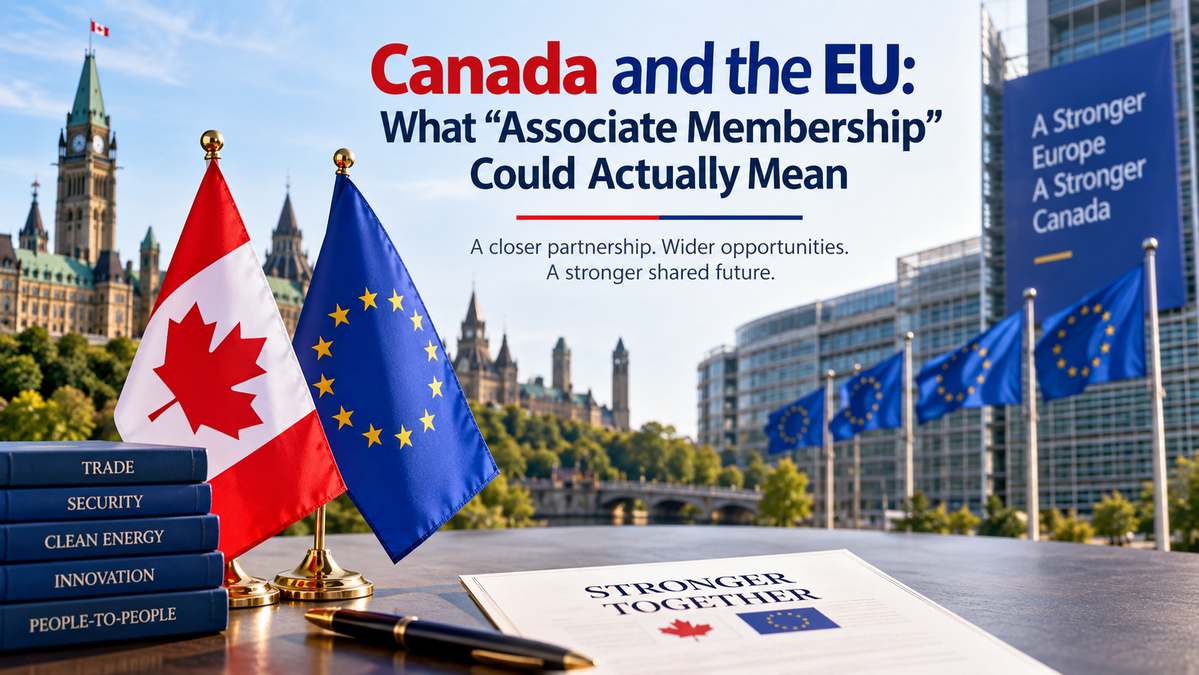
Canada is suddenly at the center of a European Union debate that could reshape how the bloc works with countries outside Europe.
European Commission President Ursula von der Leyen has proposed making Canada the EU’s first “associate member,” describing a relationship that would take cooperation far beyond the existing Canada-EU trade agreement.
The announcement has generated headlines suggesting that Canada could be joining the European Union.
It is not.
Canada has not joined the EU, has not received voting rights and has not been given access to the bloc’s single market. In fact, the EU’s treaties do not currently contain an “associate member” category at all. The proposal would have to be negotiated and accepted by the EU’s 27 member states.
That uncertainty is what makes the idea so interesting.
Rather than a conventional membership application, Europe and Canada appear to be exploring whether they can create a new type of strategic relationship.
Why Is the EU Looking at Canada Now?
The proposal comes as both sides face a rapidly changing global economic and security environment.
Canada is trying to reduce its heavy dependence on the United States, while the EU is looking to strengthen relationships with countries that can provide resources, technology, investment and defense cooperation.
Canadian Prime Minister Mark Carney has repeatedly called for a deeper relationship with Europe but has stopped short of seeking full EU membership.
Von der Leyen’s proposal goes further by suggesting a formal framework for that closer partnership.
The timing is also significant because Canada-US relations have become more difficult under President Donald Trump.
For Ottawa, Europe offers another major economic and strategic partner.
For Brussels, Canada offers access to resources, technology and a major democratic ally outside the European continent.
“Associate Member” Is a New Idea
The most important fact about the proposal is also the easiest to misunderstand.
There is currently no established EU legal status called associate membership.
Different versions of the concept have been discussed in European politics before. Germany previously floated an associate-membership idea for Ukraine, but it did not gain broad support.
Canada’s case is different because it is not seeking a route to eventual full EU membership.
Instead, Ottawa is looking for what Carney has described as a “unique alliance.”
That could allow Canada to participate more deeply in selected European programs without becoming a normal EU member.
But precisely how that would work remains unresolved.
What Could Canada Get?
The potential benefits could extend well beyond trade.
Von der Leyen has proposed moving the relationship from the existing Comprehensive Economic and Trade Agreement, or CETA, toward what she calls an “Alliance for the Future.”
Possible areas include:
- Advanced manufacturing
- Artificial intelligence
- Quantum technology
- Critical minerals
- Energy
- Batteries
- Cybersecurity
- Defense industries
- Arctic cooperation
- Economic security
The European Commission has also described the goal as creating a common prosperity and economic-security space.
If those ambitions become concrete agreements, Canada could gain greater access to European investment, industrial partnerships and strategic programs.
But Canada Would Not Get a Seat at the EU Table
There is an important trade-off.
Full EU members have voting rights in the bloc’s institutions.
An associate member would not automatically receive those rights.
That creates a difficult question: How closely could Canada be expected to follow European rules without having a direct vote over those rules?
Reuters has pointed to the example of countries closely linked to the EU single market, where extensive regulatory alignment can come without full participation in EU decision-making.
For Canada, this could become one of the most complicated parts of any eventual deal.
Closer economic integration can provide market access, but it can also require accepting rules developed elsewhere.
The Single Market Question Could Be Crucial
The EU’s single market is one of the world’s largest economic spaces.
Canada already has substantial trade access through CETA, but that is not the same thing as being inside the single market.
If an eventual associate arrangement offered Canada significantly greater access, Ottawa could face pressure to align more closely with EU standards and regulations.
That would create a basic policy choice.
Would Canada accept greater regulatory alignment in exchange for greater European market access?
Or would it prefer a looser partnership that preserves more domestic regulatory freedom?
The answer could determine what “associate membership” eventually becomes.
Canada Already Has CETA
The new proposal is not starting from zero.
Canada and the EU already have CETA, their major trade agreement.
The European Commission says trade in goods between the two sides has grown by 75% in less than a decade under the agreement.
That provides a foundation for expanding the relationship.
But CETA is primarily a trade framework.
The new proposal is much broader.
It would attempt to connect trade with defense, technology, energy and economic security.
That is a reflection of how international relationships are changing.
Critical Minerals Could Be One of the Biggest Incentives
Canada’s natural resources make the country particularly attractive to Europe.
Critical minerals are essential to batteries, electric vehicles, electronics, renewable energy and defense technologies.
European countries want to make their supply chains more resilient and reduce excessive dependence on individual foreign suppliers.
Canada, meanwhile, wants investment and dependable international markets for its resources.
That creates a strong economic reason for both sides to cooperate.
The proposed relationship could therefore be as much about industrial policy as diplomacy.
The Arctic Adds Another Layer
Canada’s Arctic geography gives the relationship a strategic dimension that ordinary trade agreements cannot provide.
The European Commission has proposed making the Arctic a flagship area of Canada-EU cooperation.
The region is becoming increasingly important because of changing sea routes, natural resources and geopolitical competition.
For Canada, Arctic cooperation involves sovereignty and national security.
For Europe, it involves access, security and the broader defense of northern Europe.
A Canada-EU partnership could therefore extend into areas traditionally associated with defense policy.
Defense Cooperation Is Already Moving Forward
Canada’s European outreach is not limited to future plans.
Ottawa has already joined the EU’s SAFE defense procurement initiative as its first non-European participant, creating another channel for cooperation between Canadian and European defense industries.
That matters because the proposed relationship is emerging at the intersection of economics and security.
Canada wants more defense partnerships as the global security environment changes.
Europe wants to strengthen its defense-industrial capacity.
The two objectives overlap.
Why the United States Is Watching Closely
Canada’s economic relationship with the United States remains far larger than its relationship with Europe.
That is unlikely to change quickly.
Canadian manufacturers are deeply integrated with American supply chains, while energy, agriculture and other industries depend heavily on cross-border commerce.
But Ottawa’s desire to build alternative relationships has grown as trade tensions with Washington have increased.
Trump has reacted sharply to the proposed Canada-EU relationship, warning that the United States could impose very heavy tariffs or restrict trade with Europe if he views the move as hostile.
Those comments were conditional; they do not mean new tariffs have already been imposed because of the EU proposal.
Nevertheless, they demonstrate how sensitive Canada’s diversification strategy has become.
Canada Is Diversifying, Not Replacing America
It would be misleading to describe the proposal as Canada choosing Europe over the United States.
Canada cannot simply replace its largest trading partner.
Geography alone makes the North American relationship uniquely important.
Instead, Ottawa appears to be pursuing a form of economic insurance.
The more markets Canada can access, the less vulnerable its economy may be to disruption in any single relationship.
Europe is one part of that strategy.
The United Kingdom and other partners are also becoming more important.
There Is a Complication for EU Candidate Countries
The Canadian proposal also creates a political question inside Europe.
Several European countries are seeking full EU membership and must go through lengthy accession processes involving regulatory and institutional reforms.
A new associate category could raise concerns if a non-European country received significant access to EU programs without undertaking the same path toward membership.
Reuters reported that the Canadian arrangement would not formally alter the accession process for candidate countries, but it could still become politically sensitive if Canada is perceived as receiving preferential treatment.
That is another reason the final design of the arrangement will matter.
Europe Must Decide What It Is Offering
For now, the proposal is much clearer in ambition than in legal detail.
The European Commission has expressed a desire to take the Canada relationship to the “highest level possible.”
But the Commission alone cannot simply create a new membership category.
The EU’s member governments would have to determine what rights, responsibilities and institutional arrangements such a relationship would involve.
That negotiation could take considerable time.
And the final agreement may be narrower than the language surrounding the initial announcement suggests.
Could Canada Become a Model for Other Countries?
This may ultimately be the most important question.
If the EU successfully creates a meaningful relationship with Canada somewhere between ordinary trade cooperation and full membership, other countries could become interested.
Britain, for example, could examine whether a similar framework would provide a way to deepen ties with the EU without rejoining the bloc.
Other democratic countries could also look at the model.
But that possibility depends entirely on what the Canada arrangement eventually contains.
If “associate membership” means little more than additional cooperation agreements, its impact will be limited.
If it provides significant access to European programs and markets, it could become a new category of international partnership.
The Bigger Shift Is From Trade to Strategic Partnerships
The Canada-EU proposal reflects a wider transformation in global economics.
Trade is no longer being discussed separately from defense.
Technology is connected to national security.
Critical minerals are connected to industrial policy.
Energy is connected to geopolitical resilience.
Supply chains are now treated as strategic assets.
That is why the proposed Canada-EU relationship is attracting so much attention even before there is a formal agreement.
It is an experiment in building a broader partnership around those interconnected interests.
What Happens Next?
The next stage will involve turning the political announcement into practical negotiations.
Canada and the EU will need to determine what the proposed relationship actually includes.
That means addressing market access, regulatory alignment, defense cooperation, technology programs, investment and institutional participation.
EU member states will also have to decide whether they support the concept.
Until then, the phrase “associate member” should be treated as a proposal, not a legal status.
Canada Is Not Joining Europe—It Is Testing a New Relationship With It
The real significance of this story is not that Canada is about to become the EU’s 28th member.
It is not.
Canada is testing whether it can build a deeper economic and strategic relationship with Europe while remaining outside the EU’s political institutions.
For Ottawa, that could provide new markets, investment and security partnerships at a time when its traditional relationship with Washington has become more uncertain.
For Brussels, Canada could become a valuable partner in technology, resources, defense and the Arctic.
And for the wider world, the experiment could answer a much bigger question:
Can a country gain some of the strategic benefits of deep European integration without becoming an EU member?
The answer will depend not on the headline announcement, but on the rules Canada and Europe eventually agree to write.