
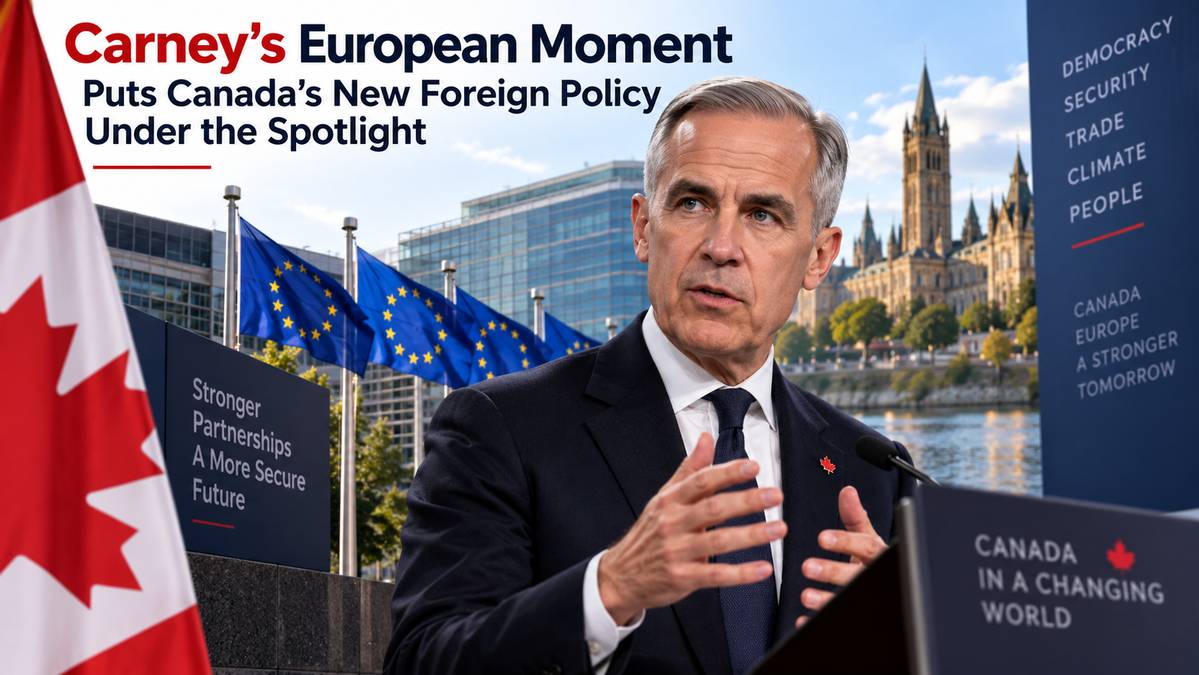
Canadian Prime Minister Mark Carney’s address to the European Parliament comes at a moment when a speech about closer ties with Europe has suddenly acquired much larger geopolitical significance.
Carney was scheduled to address lawmakers in Strasbourg on September 17, just hours after U.S. President Donald Trump warned that the European Union could face “very serious” tariffs or restrictions on trade if he considered its proposed relationship with Canada hostile to American interests.
The timing has transformed what might otherwise have been a diplomatic speech into a closely watched statement about Canada’s economic independence.
European Commission President Ursula von der Leyen proposed creating a new form of relationship that could make Canada the EU’s first associate member. But the idea is still at an early stage, and “associate member” is not an existing category under EU treaties.
What Carney says—and how Europe responds—could help define the next stage of Canada’s relationship with both sides of the Atlantic.
Canada Is Not Joining the EU
The first distinction is important.
Canada is not applying for ordinary EU membership, and it has not been admitted as an associate member.
Instead, Brussels has proposed developing an entirely new framework for closer cooperation with Ottawa.
Von der Leyen described the idea as part of an “Alliance for the Future,” with cooperation potentially extending beyond trade into manufacturing, technology, defense, energy, critical minerals, artificial intelligence, cybersecurity and the Arctic.
The proposal still needs political and legal development, including approval from EU member states.
That means the substance of the eventual arrangement could look very different from the headline.
Why Carney’s Speech Matters
Carney’s appearance comes after months of increasingly difficult relations between Ottawa and Washington.
Canada’s economy has traditionally been deeply connected to the United States. Around 70% of Canadian exports go to the U.S., making the American market extraordinarily important to Canadian businesses.
But tariffs, trade disputes and disagreements over Canadian sovereignty have encouraged Ottawa to look for additional economic and strategic relationships.
Europe has become a particularly important part of that effort.
Carney’s speech therefore gives him an opportunity to explain what Canada wants from Europe—and what it does not want.
Trump’s Reaction Has Raised the Stakes
Trump has already made clear that Washington is watching the Canada-Europe relationship closely.
He called the idea of Canada becoming an EU associate member “laughable” and said that if he viewed the arrangement as hostile, the United States could impose heavy tariffs or stop trading with Europe in some areas.
At the same time, Trump left open the possibility of accepting the idea if he considered its intentions benign.
That makes the threat conditional rather than an announcement of new tariffs.
But it also demonstrates how closely Washington is linking Canada’s foreign-policy choices with U.S. economic interests.
Brussels Says the Partnership Is Not Against Washington
The European Commission has rejected the idea that closer ties with Canada are designed to target the United States.
A Commission spokesperson said the proposed strengthening of the relationship was intended to build common strength rather than act against another country.
France has taken an even more direct position.
French Europe Minister Benjamin Haddad said the United States does not have the power to determine the European Union’s geopolitical direction.
That response illustrates the wider tension behind the dispute.
The question is no longer simply how much Canada trades with Europe.
It is whether Canada and Europe can deepen their relationship without Washington treating that cooperation as a challenge to American influence.
Carney Has Been Preparing This Argument for Months
The themes surrounding the Strasbourg speech are not entirely new.
At the World Economic Forum in Davos in January, Carney argued that smaller and middle-sized countries could lose negotiating power when dealing individually with dominant powers.
His argument was that countries need stronger partnerships to avoid negotiating from a position of excessive dependence.
That philosophy now has a practical setting.
Canada is seeking deeper cooperation with Europe precisely as its relationship with Washington becomes more difficult.
The European Parliament speech therefore provides Carney with an opportunity to turn that broader argument into a concrete foreign-policy agenda.
The Goal Is Diversification, Not a Break With America
It would be misleading to describe Canada’s European strategy as an attempt to replace the United States.
Geography makes that unrealistic.
Canada and the United States share one of the world’s most integrated economic relationships. Energy, automobiles, manufacturing, agriculture and countless supply chains cross the border every day.
Europe cannot simply substitute for that relationship.
Instead, Ottawa appears to be pursuing something more practical: more options.
A larger European relationship could reduce Canada’s dependence on a single market without eliminating the enormous economic ties that already exist with the United States.
Europe Has Reasons to Want Canada Closer
The interest is not one-sided.
Canada has resources and capabilities that are increasingly important to Europe.
Critical minerals, energy, advanced manufacturing and technology are becoming strategic issues for European governments.
Canada also occupies an important position in the Arctic, an area where security, shipping, resources and geopolitical competition are becoming increasingly significant.
Von der Leyen specifically identified the Arctic as a potential flagship area of Canada-EU cooperation.
For Europe, closer Canadian ties can therefore serve economic and security objectives at the same time.
Defense Cooperation Is Moving Alongside Trade
The relationship is already extending beyond commerce.
Canada became the first non-European country to join the EU’s SAFE defense procurement program, which is designed to support European defense investment and joint procurement.
Ottawa has also formally applied to join the British-led Joint Expeditionary Force, a defense partnership involving several Northern European NATO countries.
These developments suggest that Canada’s European strategy is not simply about finding new buyers for Canadian products.
It is also about building a wider network of security partnerships.
The New EU Status Is Still a Huge Question Mark
The biggest uncertainty may actually be inside Europe.
No established EU treaty provision currently creates an “associate member” category.
That means Brussels must determine what the concept actually means.
Would Canada receive additional access to the European single market?
Would it participate in specific European programs?
Which EU rules would it follow?
Would Canada have obligations without having voting rights?
Those questions remain unresolved.
Some EU diplomats have already expressed concerns that the proposal was not sufficiently discussed with member states and that its meaning remains unclear.
So the Canadian government is not simply accepting an already designed European package.
It is entering a negotiation whose final shape remains uncertain.
Canada and Europe Already Have a Foundation
The new initiative also builds on an existing relationship.
Canada and the EU already have the Comprehensive Economic and Trade Agreement, known as CETA.
The proposed new framework would seek to move beyond traditional trade cooperation toward broader economic and strategic integration.
That could include cooperation in areas where conventional free-trade agreements are less useful, such as AI, defense production, cybersecurity, energy security and critical minerals.
The distinction matters because modern economic security increasingly overlaps with national security.
The Arctic Could Become a Major Test
Few issues illustrate that overlap better than the Arctic.
Canada has enormous Arctic territory, while European countries have growing concerns about northern security and changing shipping routes.
The region is also becoming more important as climate change alters access to sea routes and natural resources.
A closer Canada-Europe relationship could therefore develop into something that is partly about economics and partly about long-term strategic security.
For Ottawa, cooperation with Europe could provide another layer of international support in a region where Canada has major sovereignty and security interests.
Britain’s Role Is Also Growing
Britain is another important part of Canada’s European strategy.
Although the United Kingdom is outside the EU, Canada is strengthening defense cooperation with London and other European partners.
Carney’s government has already emphasized closer Canadian-European security relationships, while Ottawa’s application to the Joint Expeditionary Force provides a concrete example.
This creates a wider network around Canada rather than a single EU-centered relationship.
The emerging strategy is therefore broader than Brussels alone.
Washington’s Concern May Be About the Principle
The most consequential part of the dispute may not be the specific details of associate membership.
It may be the principle behind it.
If Canada can build deeper relationships with Europe in defense, technology, critical minerals and trade, Ottawa could have more alternatives when negotiating with Washington.
That does not remove American economic influence.
But it could gradually change the balance of Canada’s options.
From Washington’s perspective, that could be seen as a strategic loss of leverage.
From Ottawa’s perspective, it can be presented as greater resilience.
Carney Now Has to Balance Two Audiences
The Canadian prime minister therefore faces an unusual diplomatic challenge.
European lawmakers are interested in a stronger relationship with Canada.
Canadian voters are watching how the government protects national economic interests.
And Washington is closely monitoring every sign that Ottawa is moving further away from its traditional dependence on the United States.
Carney does not necessarily need to confront Trump directly.
His broader message can instead emphasize that Canada is free to choose its international partnerships.
That distinction could allow Ottawa to pursue diversification without formally turning the issue into a confrontation with Washington.
The October Summit Could Be More Important Than the Speech
Carney’s European Parliament appearance is highly visible, but the difficult work will happen afterward.
Canada and the EU are expected to discuss the proposed relationship further at a summit in Montreal on October 29 and 30.
That meeting could begin turning the broad concept of an “Alliance for the Future” into specific areas of cooperation.
The real test will be whether the two sides can agree on practical measures rather than simply exchange diplomatic statements.
A New Chapter in Canada’s Foreign Policy
Carney’s European speech arrives at a moment when Canada’s traditional foreign-policy assumptions are being reconsidered.
For generations, Ottawa could rely on exceptionally close economic and security ties with Washington while maintaining strong relationships with Europe and other partners.
The current environment is different.
Trade disputes have exposed the risks of heavy economic dependence, while global competition over technology, energy, critical minerals and defense is encouraging countries to build wider networks.
Canada’s move toward Europe is therefore not simply about responding to one American president.
It is about preparing for a world in which relying overwhelmingly on one economic relationship carries greater risk.
The Real Question Is How Far Canada Can Go
Carney’s speech is unlikely to resolve the dispute with Washington or define the final shape of Canada’s relationship with Europe.
But it can clarify the direction Ottawa wants to take.
Canada is not seeking EU membership.
It is not abandoning the United States.
And it has not yet secured the proposed associate status.
What it is doing is exploring whether a much deeper partnership with Europe can give Canada greater economic, technological and strategic flexibility.
Trump’s response has made that experiment far more consequential.
The next stage will show whether Canada can build more room to maneuver without turning diversification into another source of confrontation.
For now, Carney’s European moment is less about joining a new bloc than about answering a much bigger question: how much independence can Canada create in a world where economic relationships are increasingly becoming instruments of geopolitical power?