
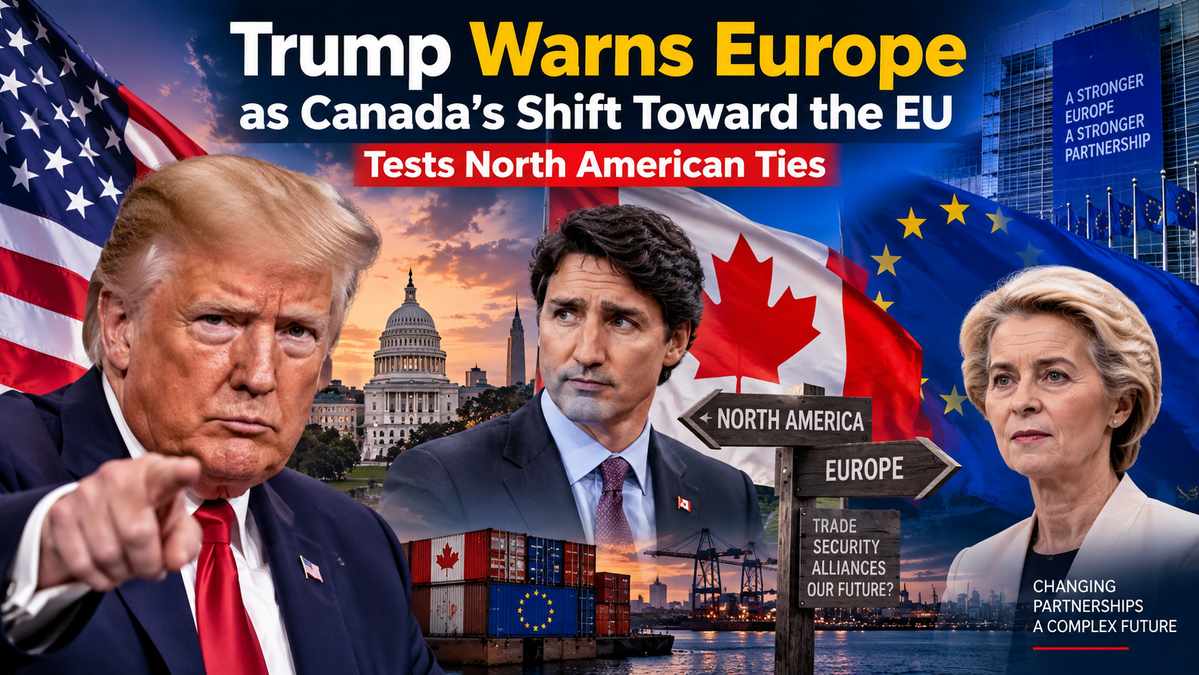
Canada’s attempt to build a closer relationship with Europe has triggered a fresh warning from U.S. President Donald Trump, turning what began as a diplomatic proposal into another potential flashpoint in the transatlantic trade relationship.
Trump warned that the European Union could face “very serious” or “very heavy” tariffs—and potentially restrictions on trade—if he decides that Europe’s proposed closer relationship with Canada amounts to a hostile move against the United States. He also dismissed the idea as “laughable.”
The dispute comes just as Canadian Prime Minister Mark Carney prepares to deepen discussions with European leaders.
But there is an important distinction behind the headlines: Canada has not joined the EU, and it has not been granted associate-member status.
European Commission President Ursula von der Leyen has proposed making Canada the bloc’s first associate member. The concept would have to be developed from scratch because such a status does not currently exist in EU treaties.
That makes the latest confrontation less about a completed agreement and more about where Canada wants its economic and strategic relationships to go next.
Canada’s European Move Is About More Than Trade
Von der Leyen’s proposal goes well beyond reducing tariffs.
She has suggested moving the Canada-EU relationship beyond their existing Comprehensive Economic and Trade Agreement, or CETA, toward what she calls an “Alliance for the Future.”
The potential areas of cooperation include technology, defense, energy, critical minerals, artificial intelligence, cybersecurity, batteries and the Arctic.
That is significant because Canada and Europe are increasingly treating economic security and national security as connected issues.
A reliable supply of critical minerals, for example, is important not only for electric vehicles and batteries but also for advanced manufacturing and defense industries.
Ottawa Is Looking for More Economic Options
Canada’s interest in Europe comes against the backdrop of a much more difficult relationship with Washington.
For decades, Canadian companies have relied heavily on the U.S. market. About 70% of Canada’s exports go to the United States, making the country exceptionally exposed to changes in American trade policy.
That dependence has become more politically uncomfortable as tariffs and trade disputes have intensified.
Ottawa’s response has increasingly been to seek alternatives.
The strategy is not necessarily to replace the United States. That would be unrealistic given geography and the depth of existing supply chains.
Instead, Canada wants more choices.
A larger European relationship could provide another market, another source of investment and another group of strategic partners.
Trump Sees the European Move Differently
From Washington’s perspective, however, Canada’s diversification strategy can have a geopolitical dimension.
Trump said he could impose serious tariffs or restrict trade with Europe if he concludes that the Canada-EU arrangement is being pursued with bad intentions.
He also described Canada as a “terrible trade partner.”
The wording is important.
Trump did not announce a new tariff package against the EU in response to the proposal.
His threat is conditional on how he interprets the European move.
That leaves room for negotiations, but it also shows that Washington is prepared to use trade policy as leverage over broader geopolitical relationships.
Brussels Says the Partnership Is Not Anti-American
European officials have rejected the suggestion that the Canada initiative is designed against the United States.
The European Commission said the proposed strengthening of ties with Canada is intended to build common strength rather than target another country.
France’s Europe Minister Benjamin Haddad also argued that the United States has no authority to determine the EU’s geopolitical choices.
That response reveals the deeper disagreement.
Washington is looking at the proposal partly through the lens of American strategic interests.
Brussels is presenting it as an exercise of European and Canadian economic and political choice.
Those two perspectives do not necessarily have to produce a trade war—but they clearly create friction.
Canada Is Not Looking for Full EU Membership
Another important point is that Ottawa is not seeking ordinary EU membership.
Canada is not a European state and does not qualify for full membership under the bloc’s existing treaties.
Instead, the proposed associate relationship would attempt to create a new middle ground between a normal external partnership and full EU membership.
Exactly what that would mean remains unknown.
Would Canada gain access to additional European programs?
Would it participate in defense projects?
Would there be deeper cooperation on technology and energy?
Would Canadian companies receive new market opportunities?
Those questions will have to be negotiated.
CETA Already Gives the Relationship a Foundation
Canada and the EU are not starting from zero.
Their existing CETA agreement has been provisionally applied since 2017 and provides a framework for trade and investment between the two sides.
The proposed “Alliance for the Future” would therefore represent an attempt to build on that foundation.
The shift would be from a relationship focused primarily on commerce toward one that also addresses strategic resilience.
That could make the partnership more important in a world where supply chains, technology and defense capabilities increasingly overlap.
Critical Minerals Could Become a Major Driver
Canada’s natural-resource base is one reason Europe has a strong incentive to deepen the relationship.
Critical minerals are becoming increasingly important to the global economy.
They are used in batteries, electric vehicles, electronics, renewable-energy systems and defense technologies.
European governments want to reduce vulnerabilities in their supply chains, while Canada wants investment and reliable international markets.
That creates a natural area for cooperation.
The same logic applies to energy.
Canada can offer resources, while Europe can provide markets, technology and investment.
The Arctic Adds a Strategic Dimension
The Arctic could become another major part of the relationship.
Von der Leyen specifically proposed an Arctic joint project as part of the broader partnership.
For Canada, the Arctic is closely connected to sovereignty, economic development and national security.
For Europe, the region is becoming increasingly important because of changing shipping routes, resource access and geopolitical competition.
Cooperation in the Arctic could therefore become one of the clearest examples of how the proposed Canada-EU relationship might extend beyond conventional trade.
Defense Cooperation Is Already Expanding
Canada’s European outreach is also moving into defense.
Ottawa has joined the EU’s SAFE defense procurement framework as its first non-European participant, while Canada is also seeking deeper cooperation with European defense partners.
That matters because the proposed Canada-EU relationship is not being developed solely as a response to tariffs.
It is part of a wider effort by Ottawa to strengthen economic and security relationships across the Atlantic.
For Canada, having more partners could reduce the risks associated with depending too heavily on a single country.
Europe Has Its Own Questions About the Proposal
The initiative is not guaranteed to become a finished agreement.
The European Commission’s proposal still needs to be developed and approved by EU member states.
There are also unresolved questions about the legal structure of associate membership and what benefits or obligations it would create.
That means the current political excitement should not be confused with a completed deal.
The negotiations could eventually produce a broad partnership—or a much narrower arrangement.
A Trade War Could Hurt Both Sides
If Trump’s warning eventually turns into new tariffs, the consequences would not necessarily be limited to Europe.
American companies are deeply connected to European supply chains, just as European companies depend on the U.S. market.
Additional tariffs could increase costs for businesses and complicate trade at a time when global companies are already trying to make their supply chains more resilient.
The same problem applies to Canada.
Ottawa wants to diversify, but the United States remains its overwhelmingly important economic partner.
A rapid separation would be costly for Canadian businesses and consumers.
Canada’s Strategy Is Better Described as Diversification
It is therefore too simplistic to describe Canada’s European initiative as an attempt to abandon America.
Canada cannot easily replace the world’s largest economy with European markets.
The geography of North America will continue to matter.
Canadian energy infrastructure, automotive supply chains, manufacturing networks and agricultural exports are deeply linked to the United States.
The objective is more likely to be creating additional options.
If Canadian businesses have stronger relationships with Europe, Asia and other markets, Ottawa could become less vulnerable to disruption in any single trade relationship.
The Dispute Reflects a Bigger Change in Global Trade
The most important story may be larger than Canada or the EU.
The global economy is moving toward a period in which trade agreements increasingly overlap with questions of security and geopolitical influence.
Critical minerals are strategic.
Energy is strategic.
Technology is strategic.
Supply chains are strategic.
That means decisions that once looked like ordinary trade policy can now provoke reactions from governments concerned about their broader geopolitical position.
The Canada-EU proposal is a clear example of that transformation.
Carney’s European Strategy Faces Its First Big Test
Canadian Prime Minister Mark Carney’s push toward Europe now faces a more complicated environment than it did only days ago.
European leaders have offered Canada the possibility of a new type of partnership.
Washington has responded with a warning.
And Ottawa must demonstrate that it can expand its international options without unnecessarily damaging its most important existing economic relationship.
That balancing act will not be easy.
But it also explains why Carney’s European outreach has become so closely watched.
The Next Stage Will Be About Details, Not Headlines
The immediate controversy is centered on Trump’s tariff warning.
But the long-term significance will depend on what Canada and the EU actually negotiate.
If they can create practical cooperation in defense, technology, energy and critical minerals, the relationship could become an important new pillar of Canada’s foreign policy.
If the proposal remains mostly symbolic, its economic impact will be much smaller.
The October Canada-EU summit in Montreal is expected to provide an opportunity for both sides to discuss the proposed relationship in greater detail.
Until then, the “associate membership” idea remains exactly that: a proposal.
A New North Atlantic Balancing Act
Trump’s warning has made one thing clear.
Canada’s effort to build closer ties with Europe is no longer being viewed simply as a trade initiative.
For Ottawa, it is about diversification and creating more strategic choices.
For Brussels, it is about strengthening economic and strategic partnerships.
For Washington, the issue touches a much broader question about America’s influence over its traditional allies and neighbors.
Those interests are now colliding.
The outcome will not be determined by one presidential statement or one European proposal.
It will depend on whether Canada and Europe can turn their ambitions into concrete agreements—and whether the United States chooses to compete with that process through negotiation, trade pressure or a combination of both.
For Canada, the larger objective remains clear: build more room to maneuver without cutting itself off from the economic relationship that has shaped its economy for generations.