
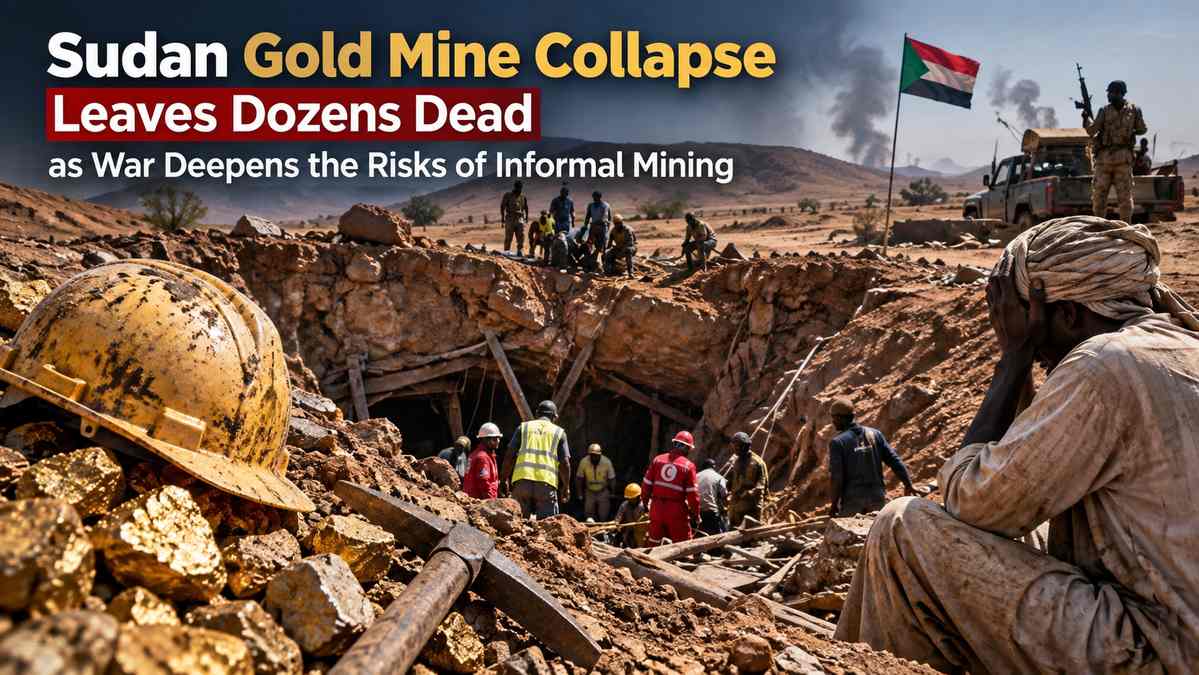
A search for gold in Sudan’s West Kordofan has turned into a desperate rescue operation after an informal mine collapsed, killing dozens of workers and leaving others trapped beneath the rubble.
The disaster struck at the al-Zara gold mine near Nuhud, where several adjoining shafts collapsed. Initial reports put the death toll at at least 70, but the number continued to change as rescuers recovered bodies. By Wednesday afternoon, local officials and activists cited by The Associated Press said 82 bodies had been recovered, while other miners were still unaccounted for.
The tragedy is not simply another industrial accident. It highlights a much bigger problem facing Sudan: a gold industry that provides vital income but operates in dangerous conditions, while the country’s prolonged war has made emergency response even more difficult.
A Mine Collapse Far From Proper Rescue Equipment
The collapse occurred at the al-Zara mine in West Kordofan, an area controlled by Sudan’s paramilitary Rapid Support Forces, or RSF. Survivors said several shafts were affected as the ground gave way.
The rescue effort immediately ran into a serious obstacle: there was little heavy equipment available.
Miners and local residents were forced to dig through soil and debris using basic tools. One survivor told reporters that workers were trying to reach people buried more than 30 metres underground but lacked the machinery needed to remove large quantities of earth and rock.
That shortage can turn a mine accident into a race against time.
Someone trapped underground may still have a chance of survival in the first hours after a collapse. But every delay makes the situation more difficult, particularly when unstable ground creates the risk of additional collapses.
The Death Toll Was Still Rising
The precise number of victims remained uncertain because rescue and recovery operations were continuing.
The Kordofan Observatory monitoring group initially said at least 70 miners had been killed or were missing. The Sudan Doctors Network later reported that 67 bodies had been recovered, while AP reported that local officials and activists had put the number at 82 by Wednesday afternoon.
These differing figures reflect the difficulty of documenting casualties at a remote mining site during an ongoing conflict.
More people could still be trapped underground, meaning the final death toll may not yet be known.
Why Informal Mining Is So Dangerous
Sudan is a major gold-producing country, but much of its production comes from artisanal and small-scale mining.
These operations can provide a critical source of income for communities, particularly in areas where formal employment opportunities are scarce. But informal mines can also operate without the engineering standards, protective equipment, structural monitoring and emergency systems normally associated with regulated mining.
The al-Zara disaster demonstrates the consequences.
When multiple shafts are dug close together in unstable ground, a collapse in one area can potentially affect adjoining workings. Survivors described exactly this kind of chain reaction at the site.
It is like removing supports from one section of a fragile structure: the danger may not remain confined to the original point of failure.
Sudan’s War Has Made the Crisis Worse
The mine collapse happened against the backdrop of Sudan’s devastating war.
The Sudanese military and the RSF have been fighting since April 2023, with the conflict dividing the country and severely damaging infrastructure and public services. West Kordofan is among the areas affected by the conflict.
That matters because rescue operations require more than people willing to help.
They need roads, machinery, medical facilities, trained rescue workers and secure access to the accident site.
When those systems are disrupted by war, even a relatively localized disaster can become much harder to manage.
At al-Zara, survivors and residents were reportedly doing much of the rescue work themselves while specialized equipment remained limited.
Gold Has Become Part of Sudan’s Wartime Economy
The importance of gold in Sudan goes beyond mining jobs.
Gold is one of the country’s major economic resources, and the sector has become closely connected to the country’s conflict economy. AP reported that large quantities of Sudanese gold have been smuggled out of the country and that experts commissioned by the United Nations have linked gold revenues to the financing of the RSF.
That creates a difficult contradiction.
For ordinary miners, gold can mean food, income and a way to survive in an economy devastated by war.
At the same time, gold revenues can contribute to wider networks of power and conflict.
The workers underground therefore occupy a very different position from the armed groups and commercial interests surrounding the gold trade. They are often people taking enormous physical risks simply to earn a living.
Mine Disasters Are Not New in Sudan
The al-Zara collapse is also part of a longer pattern.
Deadly mine collapses have occurred at other informal mining sites in Sudan. AP reported that a 2023 collapse killed 14 miners, while another in 2021 killed 38.
The repeated accidents raise questions about the conditions under which informal mining is allowed to continue and whether miners have access to adequate safety measures and emergency assistance.
For communities dependent on mining, simply shutting down the sector may not be a realistic solution without alternative sources of income.
The deeper challenge is making mining safer while addressing the economic pressures that push workers into dangerous conditions.
The Human Cost Is Bigger Than the Death Toll
Numbers can make a disaster easier to understand, but they can also hide its human dimension.
Behind every recovered body is a family that may have lost its main source of income. Behind every missing miner is a family waiting for information. And behind every survivor may be someone who now has to return to a community where mining remains one of the few available ways to earn money.
In a country already facing mass displacement, hunger and the consequences of prolonged war, another major loss of life puts additional pressure on communities that have very little capacity left to absorb it.
A Rescue Operation Against the Clock
For those still missing, the immediate priority remains the search.
But rescuers face unstable ground, deep shafts and limited machinery. Those conditions make the operation dangerous for rescuers as well as the people trapped underground.
The disaster therefore presents two urgent needs at once: finding anyone who may still be alive and safely recovering those who have died.
The longer-term challenge is even larger.
If informal mining continues to provide a major source of income, stronger safety systems and access to proper rescue equipment could prevent future accidents from producing the same devastating outcome.
Sudan’s Gold Problem Is Also a Safety Problem
The West Kordofan mine collapse has exposed something that is easy to overlook when gold production is discussed in terms of exports, revenue and war financing.
Gold does not come out of the ground by itself.
People enter unstable shafts, work with limited protection and sometimes operate in places where emergency services are difficult to reach. In Sudan, those risks are intensified by a conflict that has weakened infrastructure and divided control of territory.
The al-Zara disaster is therefore more than a mine collapse.
It is a reminder of the human cost hidden behind Sudan’s gold economy — and of how war can turn dangerous work into an even greater gamble.
As rescuers continue searching through the collapsed mine, the immediate focus remains on those still missing. But once the rescue operation ends, Sudan will face a much harder question: how can communities continue depending on gold without continuing to pay such a devastating price for it?