
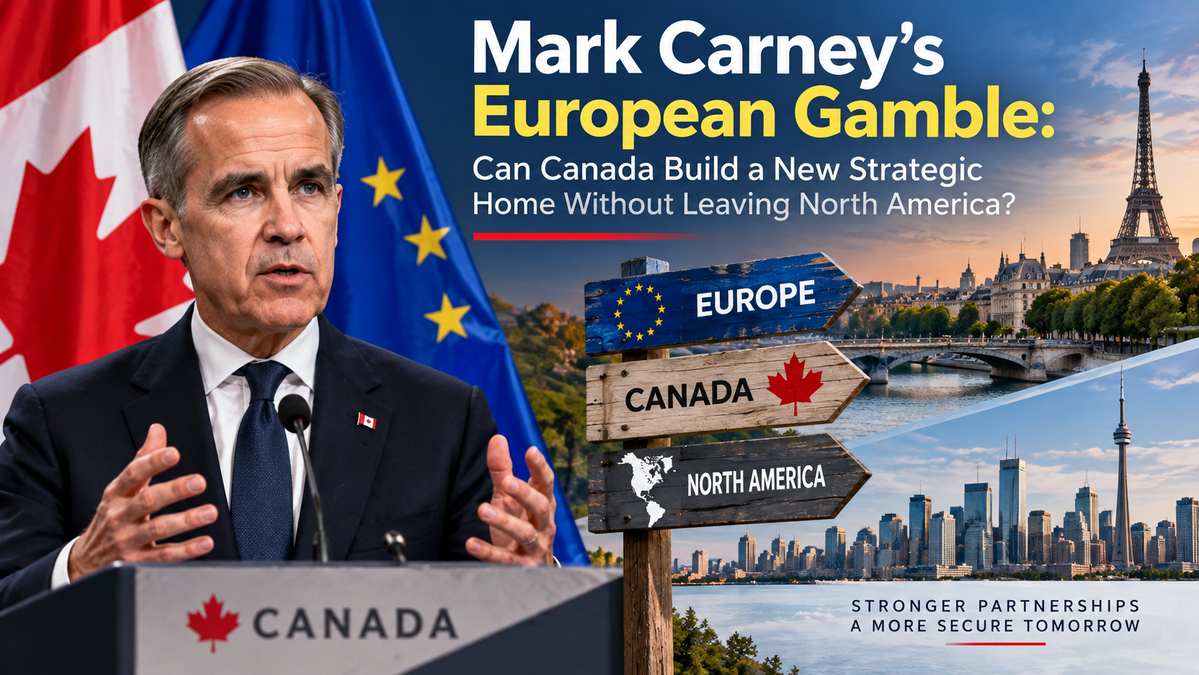
Canada is testing the boundaries of its relationship with Europe.
Prime Minister Mark Carney is pushing for a much deeper partnership with the European Union at a moment when Canada’s traditional relationship with the United States has become increasingly difficult. The idea has now taken a dramatic turn: European Commission President Ursula von der Leyen has proposed opening the door for Canada to become the EU’s first associate member.
That does not mean Canada is joining the European Union.
Carney has explicitly said Ottawa is not seeking full EU membership. Instead, Canada wants what he calls a “unique alliance” with a bloc that shares many of its political values and economic interests.
The proposal is still at an early stage. “Associate member” is not an established category under current EU treaties, and the 27 member states would have to agree on what such a relationship would actually mean.
Yet the political message is already significant.
Canada is exploring how far it can diversify its economic and strategic relationships without abandoning the North American system that has supported its economy for generations.
This Is Not Canada Applying to Join the EU
The first thing to clear up is the terminology.
Canada is not applying to become the EU’s 28th full member.
It is not seeking a seat in the European Parliament or a vote in EU institutions.
And it is not simply asking to join the European single market.
Carney has repeatedly described the objective as a new form of partnership rather than membership. Von der Leyen’s proposal goes beyond existing trade ties, but the precise legal and institutional structure has yet to be created.
That distinction matters because the political headlines can make the proposal sound much more developed than it actually is.
Right now, the idea is a framework waiting to be designed.
Why Carney Is Looking Across the Atlantic
The driving force behind the initiative is Canada’s changing relationship with the United States.
Canada has traditionally depended heavily on its southern neighbor for trade. About 70% of Canadian exports go to the United States, according to AP.
That level of integration cannot simply be replaced.
Canadian factories are connected to American supply chains. Energy infrastructure crosses the border. Businesses on both sides depend on predictable movement of goods and capital.
But recent trade tensions have encouraged Ottawa to consider what happens if its relationship with Washington becomes less predictable.
Carney’s answer appears to be diversification.
The strategy is less like moving out of one house and into another and more like building a second set of doors.
Europe Offers Something Canada Needs
The European Union gives Canada access to a huge economic market and a group of countries with significant industrial, technological and financial capabilities.
But the attraction is not simply the size of the European market.
Canada and the EU are discussing cooperation in areas that are becoming increasingly important to national security, including artificial intelligence, critical minerals, energy, advanced manufacturing, defense and the Arctic.
Von der Leyen has described the proposed relationship as an “Alliance for the Future,” with the goal of creating a broader common prosperity and economic-security space.
That represents a significant change from the traditional model of trade agreements.
The conversation is moving from tariffs and market access toward resilience and strategic capacity.
What Could Associate Membership Actually Deliver?
This is where the proposal becomes complicated.
Because associate membership does not currently exist as a defined EU status, neither Canada nor Europe has a ready-made rulebook.
The two sides could potentially develop closer cooperation in selected sectors without creating full political membership.
Areas under discussion or identified by European officials include:
- Defense-industrial cooperation
- Artificial intelligence
- Critical minerals
- Energy
- Advanced manufacturing
- Technology
- Cybersecurity
- Arctic cooperation
- Research and innovation
- Strategic supply chains
The Wall Street Journal has also reported discussions around infrastructure, data centers, cloud storage, satellite networks and closer movement of goods, services and workers in strategic sectors. Reuters has separately reported that Canada and the EU are exploring deeper cooperation across energy, AI, defense and critical minerals.
The final package, however, could look very different from the current discussions.
The Single Market Is the Biggest Complication
Canada would have to decide how much European economic integration it actually wants.
The EU’s single market is based on common rules and regulatory standards. Countries outside the EU can participate in parts of the European economic system, but deeper access can require significant alignment with EU regulations.
Norway, Iceland and Liechtenstein, for example, participate in the European Economic Area while remaining outside the EU. But their arrangements involve substantial obligations, including following many EU rules.
Canada is unlikely to simply copy that model.
Ottawa wants greater access and cooperation without surrendering the policy independence associated with being outside the EU.
Finding that middle ground could be the hardest part of the entire project.
Canada Already Has a Trade Agreement With Europe
Another reason this proposal is unusual is that Canada and the EU already have an extensive trade framework.
The Comprehensive Economic and Trade Agreement, known as CETA, provides the foundation for commercial relations between the two sides.
The proposed partnership would therefore not replace an empty space.
It would build on an existing relationship and potentially expand it into technology, defense, energy and economic security.
But CETA itself illustrates how difficult European agreements can be.
More than a decade after the agreement was signed, several EU countries have still not completed national ratification.
Creating an even broader framework will therefore require patience and political coordination.
Defense Is Becoming Part of the Relationship
The Canada-Europe relationship is also moving beyond economics.
Canada has joined the EU’s SAFE defense procurement program as its first non-European participant, creating a new channel for cooperation between Canadian and European defense industries.
That development is important because the proposed relationship is being built during a period when European countries are increasing their focus on defense capabilities.
Canada, meanwhile, wants stronger relationships with European partners.
The two trends reinforce each other.
A partnership that began with trade could eventually develop into something much broader.
Critical Minerals Could Become a Strategic Bridge
Canada’s mineral resources could provide another powerful reason for closer cooperation.
Critical minerals are essential to batteries, electric vehicles, electronics, clean-energy technologies and defense manufacturing.
Europe wants secure supply chains.
Canada wants investment, processing capacity and dependable international customers.
That creates an obvious area of mutual interest.
Rather than simply exporting raw materials, Canada could seek deeper integration into European manufacturing and technology supply chains.
That would make the relationship more valuable than a conventional buyer-seller arrangement.
Energy Is Another Major Opportunity
Energy could also become an important part of Canada’s European strategy.
European countries have been trying to diversify their energy supplies and reduce vulnerabilities associated with geopolitical disruptions.
Canada has significant energy resources but faces infrastructure and geographic challenges when trying to reach European markets.
A stronger Canada-EU relationship could encourage cooperation around infrastructure, investment and long-term energy supply.
The challenge is turning political enthusiasm into commercially viable projects.
The Arctic Gives the Partnership a Security Dimension
The Arctic may be one of the areas where Canada and Europe have particularly strong strategic interests.
Climate change is opening new economic and transportation possibilities in the region, while geopolitical competition is increasing its importance.
Canada considers the Arctic central to its sovereignty and security.
European governments increasingly view the region as part of the broader security environment of the North Atlantic and northern Europe.
Von der Leyen has specifically identified the Arctic as an area for closer Canada-EU cooperation.
That could eventually turn the Arctic into one of the defining elements of the proposed partnership.
Washington Is Watching the European Pivot
The timing of Canada’s European strategy is impossible to separate from its relationship with Washington.
U.S. President Donald Trump has reacted sharply to the EU’s proposal, calling it “laughable” and warning that Washington could impose serious tariffs or restrict trade with Europe if he considers the move hostile.
Those are conditional threats, not an announcement that new tariffs have already been imposed because of Canada’s proposed relationship with Europe.
The reaction nevertheless illustrates the geopolitical sensitivity of Canada’s diversification effort.
What Ottawa describes as building more options can be interpreted in Washington as a challenge to traditional economic influence.
Carney Is Trying to Avoid a Zero-Sum Choice
Carney’s challenge is therefore unusually delicate.
Canada cannot realistically replace the United States with Europe.
Nor does the European Union have the ability to reproduce the geographical and supply-chain advantages of Canada’s North American relationship.
The more realistic objective is diversification.
If Canada can develop stronger European, Asian and other international markets, it may have more resilience when dealing with Washington.
That does not require abandoning America.
It means making sure that America is not Canada’s only economic option.
Europe Also Has Something to Gain
The proposal is not simply a Canadian request for help.
Europe has its own reasons to pursue the relationship.
Canada offers natural resources, critical minerals, energy, advanced research capabilities, Arctic expertise and a large defense-industrial base.
It is also a major democratic country with close historical ties to European states.
For Europe, closer relations with Canada could strengthen its network of partnerships beyond the continent at a time when geopolitical competition is becoming more intense.
That makes the relationship potentially useful to both sides.
But Europe Must Agree on What It Wants
Von der Leyen can propose a new relationship, but she cannot create a new EU membership category by herself.
The European Commission is the bloc’s executive arm.
The member states will ultimately have to decide whether and how the concept moves forward.
Reuters reports that the proposal still needs to be fleshed out and approved by EU governments.
That could produce difficult negotiations.
Some governments may favor closer Canadian cooperation in defense and critical minerals but resist broader market access.
Others may question whether an entirely new membership category is necessary.
The final arrangement could therefore be considerably narrower than the initial political rhetoric suggests.
Could Canada’s Model Influence Britain?
If Canada eventually receives a meaningful middle-ground relationship with the EU, other countries could take notice.
Britain is the obvious example.
London has spent years negotiating its post-Brexit relationship with Brussels and has periodically sought deeper cooperation in areas such as defense, energy and security.
A successful Canadian model could provide another way of thinking about relationships between the EU and non-member countries.
But Britain and Canada have very different histories with the bloc, so there is no guarantee the same framework would work for both.
The Bigger Story Is Economic Independence
The most interesting part of Carney’s strategy may not be Europe at all.
It is the idea that middle-sized powers can create more room for maneuver by building overlapping networks of partnerships.
Canada cannot control the behavior of Washington.
It cannot control the direction of Beijing.
But it can attempt to increase the number of countries and institutions with which it can cooperate.
That is the logic behind the European initiative.
It is less about choosing Europe instead of America and more about reducing the consequences of having too few choices.
Carney Now Has to Turn an Idea Into a System
Political speeches can create momentum.
Agreements require something more difficult: detailed rules.
Canada and Europe will have to determine what associate membership means, which programs Canada could participate in, how much regulatory alignment would be required, whether workers could move more freely, how defense cooperation would operate and what obligations either side would accept.
Every one of those questions could produce disagreement.
The idea is therefore ambitious, but its success will depend on the details.
This Could Become a New Kind of International Partnership
If Canada and the EU manage to create a practical arrangement somewhere between a normal trade agreement and full membership, they could establish a model for future relationships.
Countries could gain deeper access to strategic programs without becoming full members of a political union.
But that model would only work if the benefits are substantial enough to justify the obligations.
Canada wants closer integration without losing sovereignty.
The EU wants stronger cooperation without weakening the meaning of membership.
Those goals can overlap, but they are not identical.
Canada’s European Moment Has Only Just Begun
Mark Carney’s European initiative is still in its early stages.
There is no Canadian EU membership application.
There is no completed associate-membership treaty.
There is no automatic access to the EU single market.
What exists is a political opening.
Von der Leyen has offered to explore an unprecedented relationship, while Carney has signaled that Canada is ready to pursue a deeper alliance.
The next step will be turning that ambition into negotiations.
And that is where the real test begins.
Canada’s future relationship with Europe will not be decided by the dramatic phrase “associate member.”
It will be decided by the practical questions underneath it: how much market access, how much regulatory alignment, how much defense cooperation and how much freedom Canada retains to set its own rules.
At the same time, Ottawa will have to manage the reality that its closest economic relationship remains with the United States.
Carney’s challenge is therefore not simply to move Canada toward Europe.
It is to build a wider international network without breaking the economic foundations Canada already depends on.
That makes his European initiative less a leap away from North America than an attempt to give Canada more room to stand on its own.