
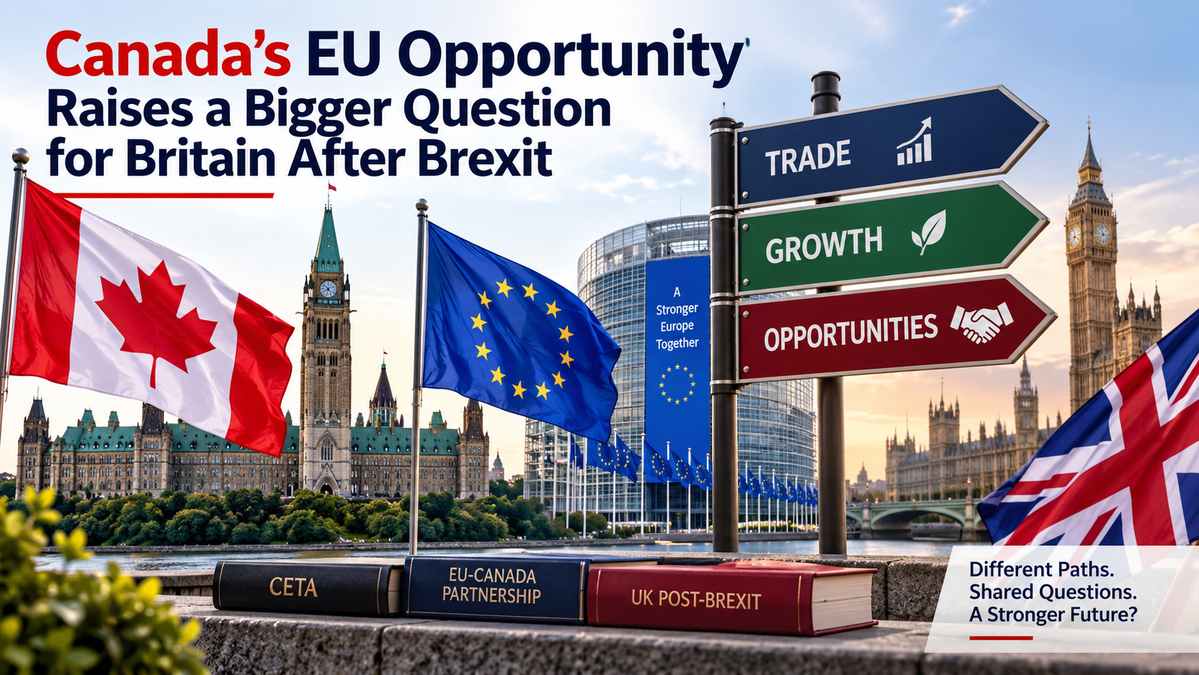
The European Union’s unexpected proposal to develop a new form of associate membership for Canada has opened a debate that reaches well beyond Ottawa.
It raises a question for Britain, too: could the relationship being explored with Canada eventually provide a model for countries that want much closer links with Europe without becoming full EU members?
European Commission President Ursula von der Leyen put the idea on the table during her State of the Union address, saying she wanted Canada to become the EU’s first associate member. The proposal would seek closer cooperation across areas including technology, defense, energy, critical minerals and economic security.
For now, however, this is an opening proposal rather than a finished agreement. The EU treaties do not contain an established category called “associate member,” meaning the practical rights and obligations would have to be negotiated.
That uncertainty makes the Canadian proposal particularly significant for Britain.
Canada Is Getting a New Kind of Conversation
Canada already has a major trade agreement with the EU, the Comprehensive Economic and Trade Agreement, or CETA.
So the new proposal is not about creating a relationship from scratch.
Instead, Brussels and Ottawa are exploring whether existing economic ties can be expanded into something much broader at a time when both sides are reassessing their strategic relationships.
Canada is looking to reduce its heavy dependence on the US market, while European governments are seeking stronger partnerships in a more uncertain global economy.
Canadian Prime Minister Mark Carney has described the goal as a “unique” security and economic alliance with Europe. Canada is already participating in Europe’s defense procurement initiative, giving the relationship a practical security dimension as well as an economic one.
Why Britain Is Watching Closely
Britain occupies a very different position.
The UK left the EU nearly a decade ago and has spent recent years trying to rebuild cooperation with Brussels without reversing Brexit.
That has produced a much narrower conversation.
The current UK-EU reset has focused on practical agreements involving areas such as food and agricultural trade, youth mobility, emissions trading and defense cooperation.
Canada’s proposed relationship, by contrast, potentially points toward a broader framework.
That does not mean Britain could simply copy the Canadian arrangement. Canada and the UK have different economic relationships with Europe, different regulatory systems and different political constraints.
But the existence of a new model could change the conversation.
The Biggest Difference Is Geography
One reason the comparison between Britain and Canada needs caution is geography.
Canada is outside Europe and has never been an EU member.
Britain, by contrast, spent decades inside the EU’s institutions and single market before Brexit.
The UK therefore has a much more complicated history with the bloc.
Any deeper relationship would have to address questions about regulatory alignment, market access, movement of people, customs arrangements and the UK’s desire to retain independent decision-making.
The EU has previously rejected attempts to give Britain only selected parts of the single market while avoiding other obligations. European governments have emphasized that the bloc’s four freedoms—goods, services, capital and people—are interconnected.
That makes the Canadian proposal interesting, but not automatically transferable.
Brussels Has Not Created a Canadian Shortcut Into the EU
It is also important not to overstate what has happened.
Canada has not been given a seat inside the EU.
It has not received voting rights.
It has not joined the single market.
And there is no established legal category of EU “associate membership” that Canada can simply enter.
The Commission’s proposal is the beginning of a negotiation.
The eventual arrangement could look very different from what observers currently imagine.
That uncertainty is one reason some European diplomats have urged caution about expectations surrounding Canada’s proposed relationship.
Trade Is Only One Piece of the Puzzle
The Canadian initiative is broader than conventional trade policy.
The EU has identified areas including critical minerals, batteries, artificial intelligence, quantum technology, cybersecurity, energy and defense industries as potential fields for cooperation.
That reflects a major change in how economic partnerships are being viewed.
Critical minerals, for example, are no longer simply a commercial issue. They are connected to batteries, electric vehicles, military equipment and supply-chain security.
The same applies to technology and energy.
The EU therefore sees closer relationships with countries such as Canada as part of a wider strategy for economic resilience.
Canada’s Resources Make It Particularly Important
Canada has something Europe increasingly wants: access to natural resources and critical minerals outside China’s supply chains.
Europe is trying to reduce vulnerabilities created by dependence on concentrated sources of important industrial materials.
Canada, meanwhile, wants reliable markets and strategic partners beyond the United States.
That creates a fairly straightforward area of mutual interest.
Britain also has significant capabilities in areas such as finance, technology, defense and advanced manufacturing, but its relationship with the EU is already shaped by Brexit-era arrangements.
The Canadian case therefore demonstrates the potential value of strategic partnerships without necessarily providing Britain with a ready-made template.
Britain’s Existing Reset Is Still More Limited
The UK has not been standing still.
Britain and the EU have been working toward closer cooperation, particularly in food trade, youth mobility and security.
But progress has been complicated by disagreements over how far the relationship should go.
More recently, Britain’s concerns about proposed EU “Made in Europe” rules have added another issue to the negotiations. British officials fear that European industrial policies could disadvantage UK companies in important sectors, while EU policymakers are also under pressure to protect European industry from growing Chinese competition.
That illustrates the central problem facing London.
Britain wants greater access to European opportunities while preserving substantial regulatory independence.
Brussels, meanwhile, wants cooperation that does not allow countries outside the bloc to select only the benefits they prefer.
Canada and Britain Are Starting From Different Places
There is another important distinction.
Canada is trying to build something new with Europe.
Britain is trying to renegotiate aspects of something it once had.
That difference matters politically.
For Ottawa, closer European integration can be presented as diversification.
For London, closer integration inevitably touches the unresolved domestic debate over Brexit.
The same policy can therefore have very different political meanings in the two countries.
The Canadian Proposal Could Still Change Britain’s Options
Even if Canada’s eventual arrangement turns out to be relatively limited, the proposal could have consequences for Britain.
It demonstrates that Brussels is willing to consider new forms of cooperation with countries outside the EU when strategic circumstances change.
That does not mean the EU will offer Britain identical terms.
In fact, Britain’s history with the bloc could make its negotiations more complicated.
But it does suggest that the architecture of Europe’s external partnerships is not necessarily fixed.
The EU already maintains close relationships with countries such as Norway, Iceland and Switzerland, although those arrangements come with their own obligations and institutional structures.
Brexit’s Original Choices Are Back in the Spotlight
The development also brings an old Brexit question back into view.
The central issue is not simply whether Britain should “rejoin” or remain outside.
There is a much wider spectrum between full membership and a distant trading relationship.
The Canadian proposal could encourage policymakers to explore what that middle ground might look like.
But it could also expose the limits of such arrangements.
Closer economic integration generally requires accepting some common rules. The more access a country wants, the more difficult it can become to maintain complete regulatory independence.
That trade-off has been at the heart of Britain’s relationship with the EU since Brexit.
Europe’s Strategic Priorities Are Changing
The wider geopolitical environment may be the biggest reason this debate is emerging now.
The EU is dealing simultaneously with the war in Ukraine, competition with China, concerns over critical supply chains and uncertainty in its relationship with the United States.
In that environment, traditional distinctions between “trade partners” and “security partners” are becoming less useful.
Canada fits naturally into that new thinking because it is a democratic country with substantial natural resources, advanced industries and growing defense cooperation with Europe.
Britain has many of those characteristics as well.
The question is how far London and Brussels are prepared to go in turning those shared interests into institutional cooperation.
Canada May Be Opening a Door Britain Has Been Approaching From the Side
The most significant aspect of the Canadian proposal may therefore be less about Canada itself and more about what it tells the rest of the world.
The EU appears increasingly interested in building flexible partnerships with countries that share strategic interests but are not seeking traditional full membership.
For Canada, that could provide a way to deepen ties with Europe while maintaining its own national institutions.
For Britain, it creates an intriguing comparison—but not an automatic blueprint.
The details will matter enormously.
If Canada’s eventual arrangement offers meaningful access to European markets, closer defense cooperation and participation in strategic programs without full EU membership, pressure could grow in Britain for a similar discussion.
If the arrangement proves too complicated or limited, the lesson could be very different.
The Real Test Comes During Negotiations
For now, the Canadian proposal is best understood as the beginning of a conversation.
The EU and Canada already have substantial economic ties, and their next step is to determine whether those ties can be expanded into a broader strategic partnership.
A planned EU-Canada summit in late October is expected to provide an opportunity to develop that relationship further.
Britain will be watching.
But rather than simply asking whether the UK can copy Canada, the more useful question may be this:
How much economic and strategic integration can a country achieve with Europe while remaining outside the EU’s political institutions?
Canada may become the first major test of that question.
And whatever answer emerges could influence Britain’s own relationship with Europe for years to come.