
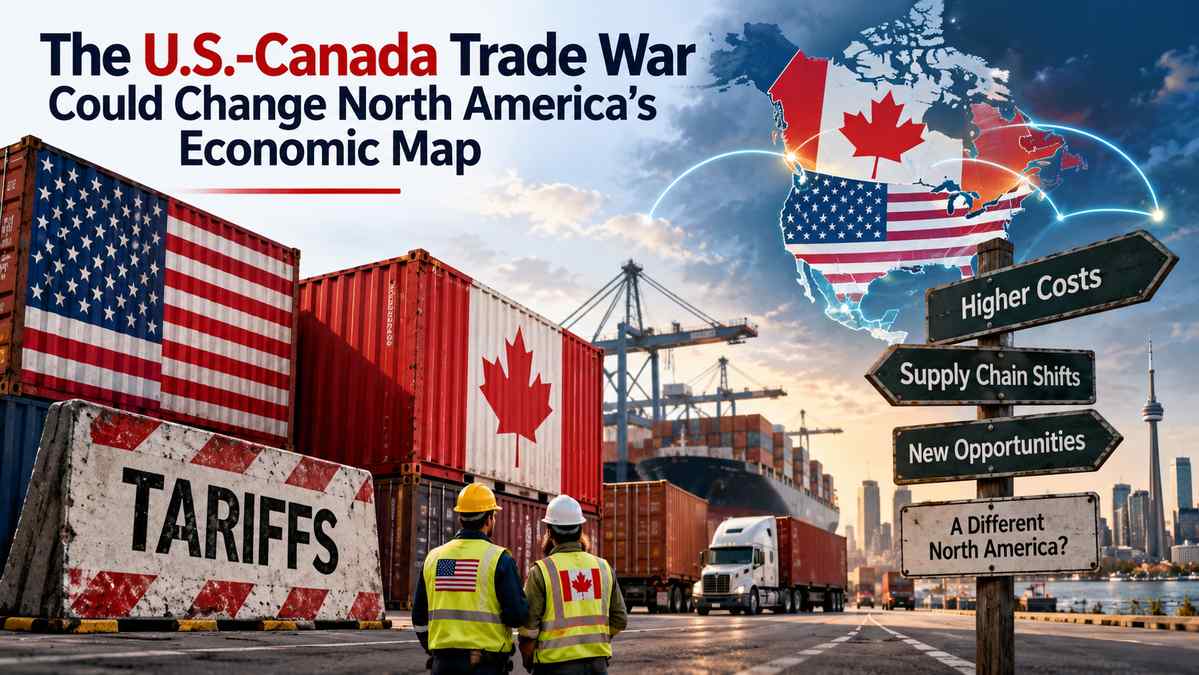
The latest U.S.-Canada trade dispute may eventually end with another agreement. Tariffs could be reduced, negotiations could restart and businesses on both sides of the border could return to something resembling normality.
But the deeper damage may be harder to repair.
For decades, Canada and the United States built one of the world’s most integrated economic relationships. From the 1965 Auto Pact to the 1988 free-trade agreement, NAFTA and eventually the United States-Mexico-Canada Agreement, the direction was largely the same: fewer barriers, more cross-border production and greater economic dependence.
The current trade conflict is putting that model under unprecedented political pressure.
And even if Washington and Ottawa eventually reach another deal, Canada may no longer be willing to build its economic future around the assumption that access to the U.S. market will always be predictable.
A Trade Dispute Has Become a Strategic Question
The immediate disagreement is about tariffs and market access.
But the larger issue is much more fundamental: How much economic dependence should one country accept when its largest trading partner can change the rules?
The Council on Foreign Relations notes that more than 70% of Canadian exports go to the United States. That concentration has historically been an enormous advantage because Canadian producers gained access to the world’s largest economy while American companies benefited from deeply integrated North American supply chains.
The same integration is now creating vulnerability.
When Washington imposes substantial tariffs on Canadian goods, Canadian exporters cannot simply replace the U.S. market overnight.
That makes diversification difficult—but increasingly attractive.
The Latest Tariff Fight Is Different
Trade disputes between Washington and Ottawa are not new.
The two countries have argued for decades over issues ranging from softwood lumber to dairy and poultry protection.
What has changed is the scale and political context of the current confrontation.
CFR’s analysis says the United States imposed 50% tariffs on $27.6 billion of Canadian exports after negotiations broke down. Canada responded with retaliatory measures of its own.
The dispute has therefore moved beyond the traditional pattern in which one side complains, negotiates and eventually compromises.
Both governments are demonstrating that they are prepared to absorb economic costs to defend their positions.
That changes the psychology of the relationship.
Canada Is Starting to Treat Diversification as Insurance
For years, expanding trade outside the United States was useful but not essential for Canada.
That calculation is changing.
Prime Minister Mark Carney has pledged to double Canada’s non-U.S. trade over the next decade, while his government is pursuing closer relationships with Europe in areas including trade, defense, technology and digital security.
Canada has also formally applied to join the UK-led Joint Expeditionary Force, another indication that Ottawa is looking to broaden its strategic relationships beyond Washington.
These moves do not mean Canada can quickly replace the United States.
They do show that diversification is becoming a long-term policy objective rather than simply a response to one tariff dispute.
Europe Is Becoming More Important to Ottawa
Canada’s European strategy has gained momentum at precisely the moment its relationship with Washington has become more uncertain.
European Commission President Ursula von der Leyen has proposed developing a new form of relationship that could make Canada the EU’s first associate member. The proposal is still at an early stage, and “associate member” is not an established status under the EU treaties.
The potential areas of cooperation go far beyond conventional trade.
They include defense production, artificial intelligence, critical minerals, energy and economic security.
That matters because Canada has resources and industrial capabilities that Europe wants, while Canada is looking for additional markets and strategic partners.
The United States Still Has an Enormous Advantage
Diversification, however, does not mean detachment.
The geography of North America makes the U.S.-Canada relationship unusually difficult to replace.
Canadian factories are deeply connected to American supply chains. Energy moves south through extensive infrastructure. Millions of dollars’ worth of goods cross the border every day.
Canada can increase exports to Europe and Asia, but those markets cannot simply reproduce the logistical advantages of selling to the country next door.
That is why the current dispute is so consequential.
Canada is not choosing between two equivalent markets.
It is trying to reduce its exposure to one overwhelmingly important market without destroying the benefits of being economically connected to it.
The Auto Industry Shows What Is at Stake
Few industries demonstrate the depth of North American integration better than automobiles.
Parts can cross the U.S.-Canada border multiple times before a vehicle reaches a customer.
A tariff imposed at one stage can therefore raise costs throughout the production chain rather than affecting only the final product.
CFR notes that U.S. officials have pushed for greater localization of automotive production, while Canadian officials have faced pressure over how much manufacturing should remain integrated across the border.
Breaking those supply chains apart would not be as simple as moving a factory from one country to another.
It could mean rebuilding supplier networks, changing investment decisions and increasing production costs.
The same principle applies to aerospace and other advanced manufacturing industries.
Energy Creates Another Layer of Dependence
The energy relationship is even more difficult to unwind.
Canada sends roughly four million barrels of oil per day to the United States, according to CFR’s analysis. That flow remains one of the most important economic links between the two countries.
This creates mutual dependence.
Canada needs a major market for its energy exports.
The United States benefits from Canadian supplies.
That does not eliminate political conflict, but it gives both sides reasons to avoid allowing the trade dispute to spiral indefinitely.
The USMCA Is Under Greater Pressure
The North American trade framework was designed for a world in which relatively open trade was the norm.
That environment has changed.
The Trump administration has used tariffs more aggressively across international trade, while Canada has responded with its own measures.
CFR experts have argued that the progressive expansion of tariffs is reducing the amount of genuinely tariff-free trade within North America.
That raises an uncomfortable question about the future of the USMCA.
A trade agreement can remain legally in place while becoming less economically meaningful if enough major sectors are subjected to tariffs or other restrictions.
The agreement’s name may survive.
The underlying model could still change.
Canada Is Not Simply Moving Toward Europe
It would also be misleading to describe Canada’s strategy as a complete pivot from the United States to Europe.
Ottawa has strong reasons to maintain its relationship with Washington.
The two countries share a border, extensive defense cooperation and highly interconnected industries.
Canada is instead trying to create more options.
That means Europe, the United Kingdom, Asia and other markets can become additional destinations for Canadian goods and investment.
The goal is less about replacing one relationship than reducing the consequences if that relationship becomes unreliable.
Washington Could Also Pay a Price
The economic effects are not limited to Canada.
American companies rely on Canadian raw materials, energy and intermediate goods.
Tariffs can raise input costs for U.S. manufacturers and force companies to search for alternatives that may be more expensive or less efficient.
CFR’s analysis notes that the direct cost of the latest tariff measures is relatively modest compared with the overall U.S. economy, but the wider consequences for supply chains and trade relationships can be more significant.
That is why the dispute is not simply a story about Canada absorbing American pressure.
The United States also has something to lose if North American production becomes less integrated.
Canada’s European Push Could Accelerate the Change
The timing is particularly significant.
As Washington and Ottawa struggle over tariffs, Canada is simultaneously deepening conversations with Brussels.
Carney has been seeking what he describes as a “unique alliance” with Europe, while Canadian officials have discussed cooperation in defense, technology, trade and digital security.
Canada is also moving toward closer defense cooperation with European countries.
Taken together, these steps suggest that the current trade dispute may be producing a structural response rather than merely a temporary diplomatic one.
The Bigger Risk Is a Permanent Loss of Trust
Tariffs can eventually be removed.
Trust is harder to restore.
Businesses make long-term investment decisions based on expectations about future market access.
If companies begin to believe that North American trade rules can change suddenly, they may reconsider where to build factories, where to locate suppliers and which markets to prioritize.
Those decisions can outlast the politicians who created the dispute.
That may be the most important consequence of the current conflict.
A Deal Could End the War Without Restoring the Old Relationship
Washington and Ottawa could still reach a compromise.
Indeed, the CFR analysis notes that Trump has at times expressed optimism about reaching an agreement.
But a future deal would not necessarily restore the pre-dispute relationship.
Canadian policymakers have now seen the risks associated with relying heavily on one market.
That experience is likely to influence trade policy even after tariffs are reduced.
The same is true for businesses.
Once companies begin building alternative supply chains and developing new customers abroad, some of those changes may become permanent.
North America’s Economic Model Is Entering a New Phase
The most important question is therefore not whether the United States and Canada can stop today’s tariff fight.
It is whether they can preserve the economic integration that made the two countries unusually prosperous together.
Canada has little practical choice but to remain closely connected to the United States.
But it increasingly has an incentive to build alternatives.
Europe’s growing interest in Canada, Ottawa’s push toward Asian and European markets and its expanding defense relationships all point in the same direction.
The result may not be a dramatic economic divorce.
It could be something more gradual: a North American relationship that remains enormous but is no longer Canada’s only economic option.
That could be the lasting legacy of this trade war.
Even if the tariffs disappear, the calculation behind Canada’s trade strategy may never return to what it was before.