
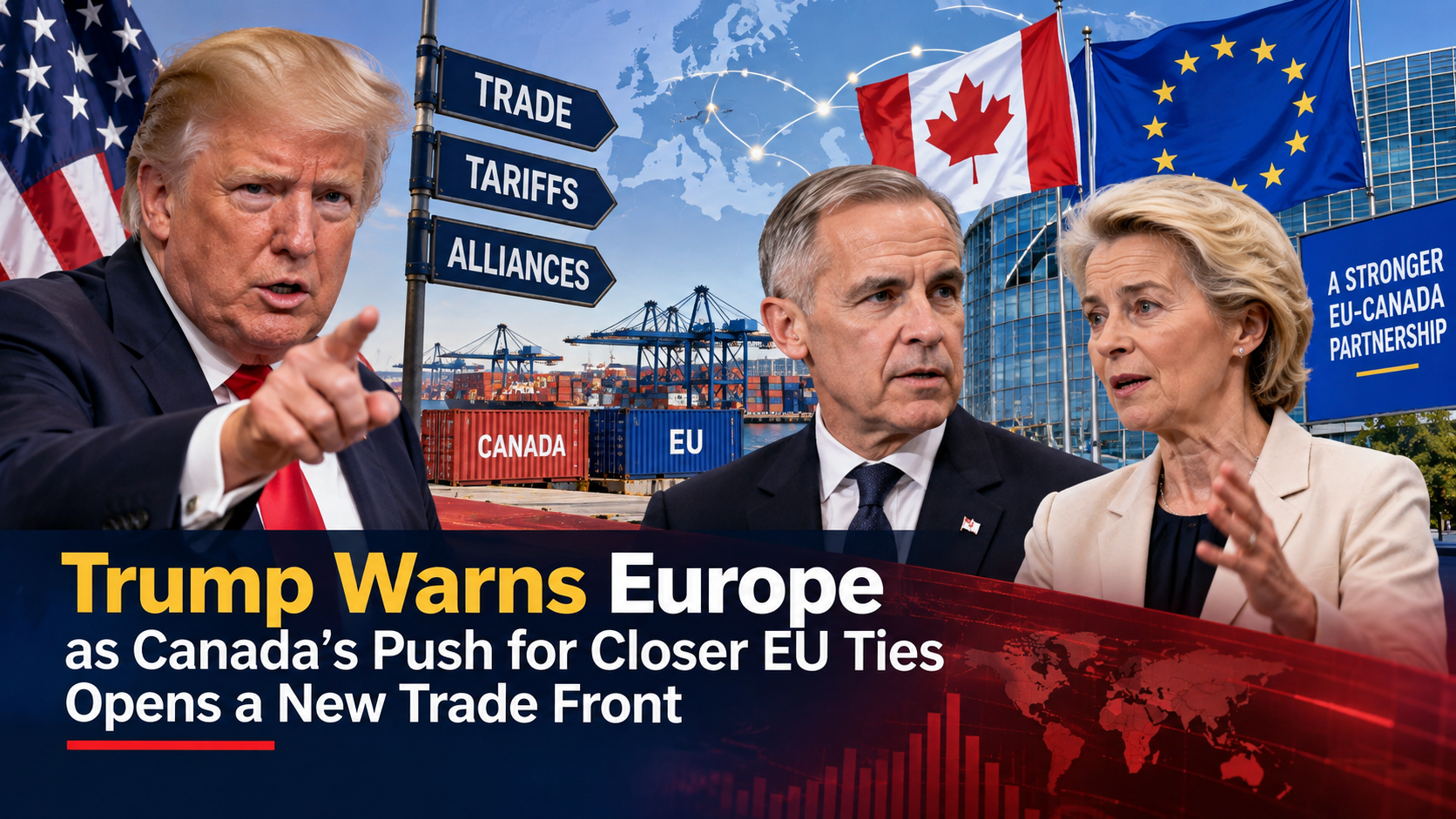
A proposal to bring Canada closer to the European Union has triggered a fresh warning from U.S. President Donald Trump, adding another layer of uncertainty to an already strained relationship between Washington, Ottawa and Brussels.
Trump said the United States could impose what he described as “very serious” tariffs or restrict trade with Europe if the EU moves ahead with plans to make Canada its first associate member and he concludes the move is hostile toward the United States. He also dismissed the proposal as “laughable.”
But the proposed European arrangement is far from finalized.
Canada has not joined the EU, and there is currently no formal “associate member” category in the bloc’s treaties. Any new framework would have to be negotiated and approved by EU member states.
That makes the dispute about more than a new membership label. It is becoming a test of how freely Canada and Europe can deepen their economic and security relationship while Washington watches closely.
A Proposal That Is Bigger Than Trade
European Commission President Ursula von der Leyen put Canada at the center of her State of the Union address in Strasbourg.
She proposed opening the door for Canada to become the EU’s first associate member and described a relationship that would extend well beyond conventional trade.
Potential areas include advanced manufacturing, technology, defense production, the Arctic, artificial intelligence, energy, critical minerals, batteries, cybersecurity and economic security.
In other words, Brussels is discussing a strategic partnership rather than simply another trade agreement.
That distinction helps explain why the proposal has attracted such a strong reaction from Washington.
Canada Is Looking for More Options
Canada’s interest in Europe comes as its economic and political relationship with the United States faces greater uncertainty.
The two North American economies remain deeply connected, but tariffs and repeated disputes have encouraged Ottawa to look for additional markets and strategic partners.
Canadian Prime Minister Mark Carney has described his country’s objective as building a “unique alliance” with Europe rather than seeking EU membership.
The proposed partnership could give Canada another avenue for cooperation in areas where Europe is seeking stronger relationships, particularly critical minerals, energy, technology and defense.
It would not replace the United States.
But it could give Ottawa more room to maneuver.
Trump Sees a Potential Strategic Problem
Trump’s reaction suggests Washington is watching Canada’s European strategy through a different lens.
For the United States, Canada is not simply another foreign trading partner. The two countries share an enormous integrated market, extensive energy infrastructure, supply chains and a long-standing defense relationship.
A closer Canada-Europe relationship could therefore change the balance of economic and strategic partnerships around the North Atlantic.
Trump did not say that tariffs would automatically follow the Canadian proposal.
Instead, he tied any response to whether he considers Europe’s intentions hostile.
“If it’s a good intention, that’s fine,” Trump said, while warning of heavy tariffs if he concludes otherwise.
That conditional language is important.
For now, the threat is a warning rather than a new trade measure.
Brussels Rejects the Idea That Canada Is an Anti-American Project
European officials have pushed back against the suggestion that the proposed relationship is designed against Washington.
The European Commission has characterized the initiative as an effort to strengthen common capabilities rather than target another country.
France’s European Affairs Minister Benjamin Haddad went further, saying the United States does not have the authority to determine Europe’s geopolitical direction.
That response highlights a broader issue.
European governments increasingly want the ability to build partnerships based on their own economic and security interests, even when those decisions do not align perfectly with Washington.
The Proposal Is Still Legally Uncharted Territory
The phrase “associate member” sounds established, but it is not.
EU treaties currently do not define such a membership category.
There are already different forms of close cooperation between the EU and countries such as Norway, Iceland and Switzerland, but those arrangements have their own legal structures and obligations.
Creating a new Canadian framework would therefore involve difficult questions.
How much access would Canada receive to the EU single market?
Which European rules would Canada have to follow?
Would Canadian companies gain additional market opportunities?
How much participation would Ottawa have in programs where it has no formal voting rights?
And perhaps most importantly, how would such an arrangement fit alongside Canada’s existing trade relationship with the United States?
Those questions have yet to be answered.
Canada Already Has a Trade Agreement With Europe
The proposed partnership would also build on an existing foundation.
Canada and the EU already operate under the Comprehensive Economic and Trade Agreement, commonly known as CETA.
That agreement has substantially reduced many trade barriers between the two economies, although it has not been fully ratified by every EU member state even years after its provisional application began.
The new proposal would therefore represent an attempt to expand an existing relationship rather than create one from nothing.
The potential shift is from trade cooperation toward broader strategic integration.
Defense Is Becoming Just as Important as Commerce
The timing of Canada’s European outreach is significant because Ottawa is also looking to strengthen defense links outside its traditional U.S.-centered framework.
Canada has formally applied to join the UK-led Joint Expeditionary Force, a military cooperation group involving 10 Northern European countries.
That does not mean Canada is abandoning cooperation with the United States.
Instead, it shows how Ottawa is building additional relationships at a time when North American political ties have become less predictable.
Defense, technology, Arctic security and critical infrastructure are increasingly connected to economic policy.
The Arctic Could Become a Major Piece of the Relationship
The Arctic may eventually become one of the most important areas of Canada-EU cooperation.
Von der Leyen specifically identified the Arctic as a potential flagship joint project.
Canada has enormous Arctic territory, while European countries have growing interests in northern security, shipping routes, energy and geopolitical competition.
As climate change makes northern sea routes more accessible and competition among major powers intensifies, the Arctic is becoming increasingly important to both economic and security planning.
A closer Canada-Europe relationship could therefore have consequences far beyond tariffs.
Critical Minerals Give Both Sides Another Reason to Cooperate
Canada also has resources that Europe increasingly wants.
Critical minerals are essential for batteries, electric vehicles, renewable-energy technologies, electronics and defense systems.
European governments are trying to reduce dependence on concentrated global supply chains, while Canada is looking for reliable markets and investment partners.
That creates a natural area of mutual interest.
A deeper relationship could allow Canadian resources and European technology and manufacturing capabilities to become more closely connected.
Britain Is Watching Too
The dispute also has implications for Britain.
The UK is no longer part of the EU, but it remains closely connected to both Canada and Europe.
Canada’s push for a new relationship with Brussels is therefore occurring alongside efforts to strengthen Canadian defense and economic ties with Britain.
That creates the possibility of a broader network linking Canada with several European powers without requiring Ottawa to become part of the EU’s traditional membership structure.
It also raises questions about whether Europe is gradually developing new forms of partnership for countries that want deeper cooperation without full membership.
Washington Still Has Considerable Economic Leverage
Despite Canada’s European ambitions, the United States remains extraordinarily important to the Canadian economy.
The geographic reality is difficult to change.
Canadian manufacturers are integrated into U.S. supply chains, Canadian energy flows heavily southward, and businesses on both sides of the border depend on cross-border commerce.
Europe can provide Canada with additional markets and partnerships, but it cannot immediately reproduce the economic advantages of sharing the world’s longest international border with the United States.
That means Ottawa’s strategy is more accurately described as diversification rather than replacement.
The EU Has Its Own Complications
The Canadian proposal also faces challenges within Europe.
Any new arrangement would require support from EU member states, and questions about its legal structure, market access and obligations remain unresolved.
Some European policymakers have also questioned how ambitious the proposal should be.
That means the biggest obstacle may not necessarily come from Washington.
Brussels itself must determine what it is actually prepared to offer Canada.
A New Trade Conflict Is Not Inevitable
Trump’s warning raises the possibility of another U.S.-EU trade confrontation, but it would be premature to treat escalation as certain.
The proposed Canadian arrangement has not yet been finalized.
There is also no indication that the EU has accepted all of the terms that an eventual associate relationship might contain.
Much will depend on negotiations between Canada and the EU—and on how Washington interprets the final arrangement.
For businesses, that uncertainty may be more important than the political rhetoric.
Companies need to know whether tariffs will change, whether market-access rules will shift and whether supply chains will remain predictable.
The Bigger Story Is About Who Gets to Build New Alliances
The dispute reveals a broader change in international economics.
For decades, the United States, Canada and Europe operated within a relatively stable Western economic framework.
That framework is becoming more complicated.
Canada wants more options.
Europe wants greater strategic capacity.
The United States wants to protect its economic and geopolitical influence.
Those objectives can overlap, but they can also collide.
The proposed Canada-EU relationship has exposed that tension unusually clearly.
Canada’s European Move Could Change the Conversation
The immediate issue is whether Canada can develop a new form of partnership with the EU.
But the longer-term question is much larger.
Can countries deepen economic, technological and defense cooperation without becoming formal members of the same political bloc?
Canada could become an important test case.
If Brussels and Ottawa succeed in creating a meaningful framework, other countries may examine the model.
If negotiations become bogged down by legal, regulatory and political obstacles, the proposal could instead demonstrate how difficult it is to build a middle ground between ordinary trade relations and full membership.
For now, Canada’s European strategy remains unfinished.
So does the U.S. response.
What is already clear, however, is that the old assumption of a fixed North American-Western economic alignment is being tested from several directions at once.